Frontend and full-stack frameworks
Frontend frameworks organize your site's pages, rendering and data loading.
Use for: Websites, dashboards and full-stack web apps.
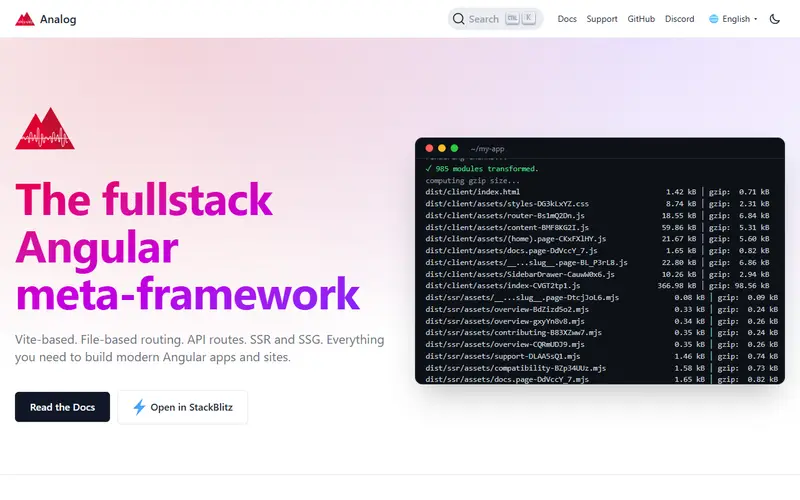
The Angular meta-framework: Vite builds, file-based routing, API routes, Markdown content routes and hybrid SSR/SSG, with Nitro presets for deployment.
Google's TypeScript application framework with its own component model, router, forms, HTTP client and CLI, plus built-in hybrid rendering (SSR, prerender, CSR per route).
MIT-licensed framework for content-driven sites that renders HTML on the server, ships zero JavaScript by default and hydrates only the interactive islands you mark.

Meta's React and MDX static site generator for documentation, with versioned docs, i18n, blog, search integration and theme swizzling out of the box.
Simple, fast JavaScript static site generator that injects no markup of its own and supports a dozen template languages; renamed Build Awesome in March 2026 under Font Awesome.
Deno's web-standards framework: server-rendered pages with Preact islands for interactivity, a small middleware-style API, built-in OpenTelemetry and, since Fresh 2, a Vite plugin.

Once-leading React static site generator with a GraphQL data layer, owned by Netlify since 2023 and now kept in limited maintenance: security fixes and compatibility updates, no new direction.
Static site generator written in Go and distributed as a single binary, known for rendering large sites in seconds, with multilingual support, taxonomies, asset pipelines and Hugo Modules.
Rust framework for full-stack web apps with fine-grained reactive signals, server-side rendering, WebAssembly hydration and #[server] functions that cross the client-server boundary.
Vercel's MIT-licensed full-stack React framework with the App Router, React Server Components, Turbopack builds and, since 16.2, a stable adapter API for other hosts.
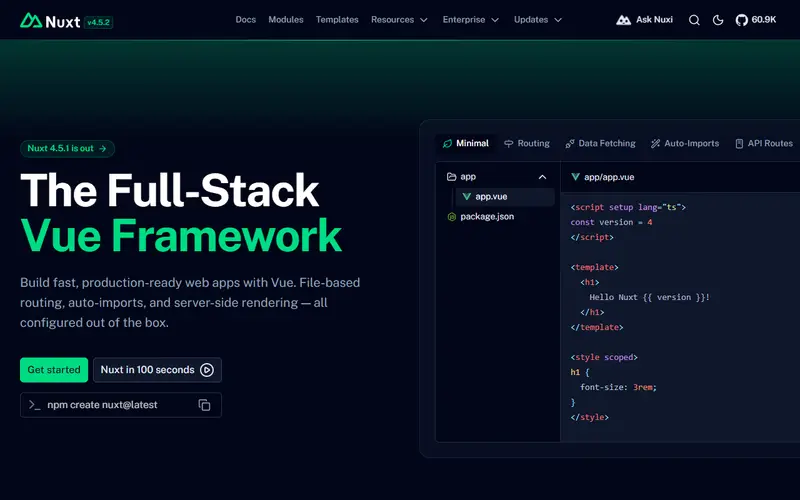
The main full-stack framework for Vue: file-based routing, auto-imports, hybrid rendering and the Nitro server engine, which builds for Node, static hosting, serverless or edge.
JSX framework that skips hydration: pages resume where the server left off and load small pieces of JavaScript only when the user interacts, with Qwik City (Qwik Router) for routing.
The most used JavaScript UI library, now owned by the React Foundation under the Linux Foundation; react.dev recommends starting new apps with a framework such as Next.js or React Router.

The long-running React router whose v7 absorbed Remix: use it as a plain router, or in framework mode with loaders, actions, SSR, SPA or static output via a Vite plugin.
The successor to RedwoodJS: a Vite-plugin React framework with Server Components, server functions and realtime state, built only for Cloudflare Workers, D1, R2 and Durable Objects.
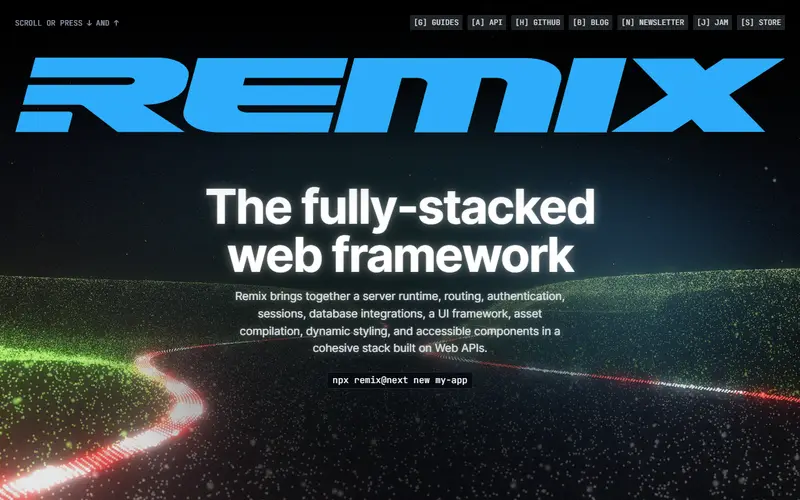
The Remix team's new, React-free full-stack framework in a single package: server runtime, routing, auth, sessions, database tooling, its own UI runtime and components, built on Web APIs.
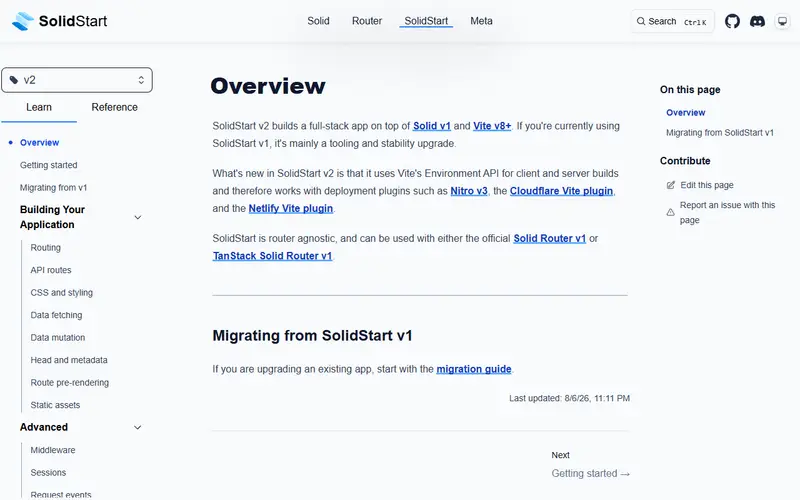
Meta-framework for SolidJS with CSR, SSR and SSG; v2 (August 2026) moved to Vite and Nitro v3, but the Solid team is retiring it in favour of Solid 2.0's built-in start mode.

The Astro team's documentation framework: Markdown, MDX or Markdoc pages with navigation, search, i18n and components, output as static HTML with little JavaScript.
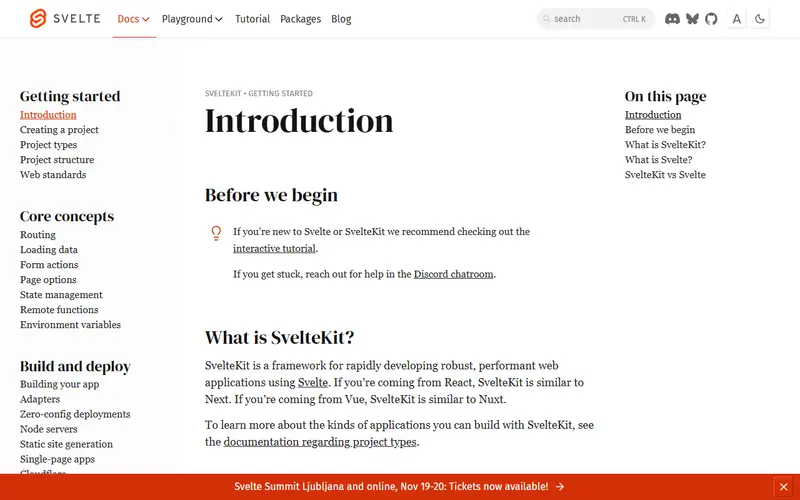
The official Svelte application framework: file-based routing, per-route SSR, CSR or prerendering, and small adapters that target Node, static hosts, Vercel, Netlify or Cloudflare.
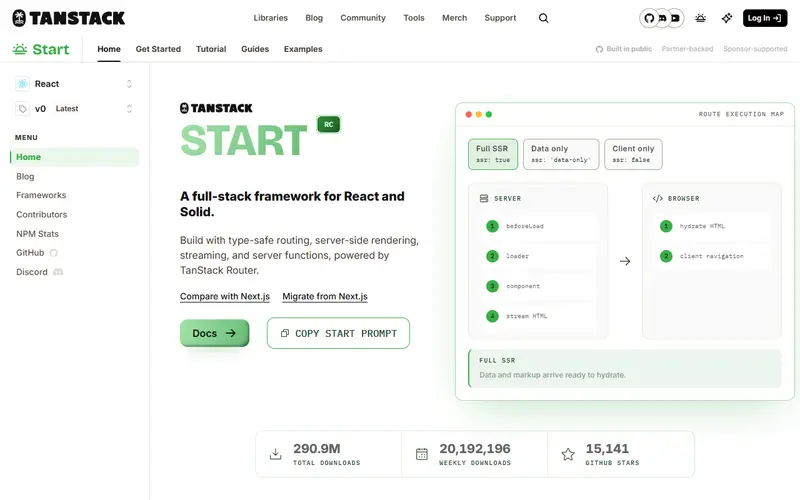
Full-stack framework built on the type-safe TanStack Router, adding full-document SSR, streaming, server functions and middleware, with Vite or Rsbuild builds for many hosts.
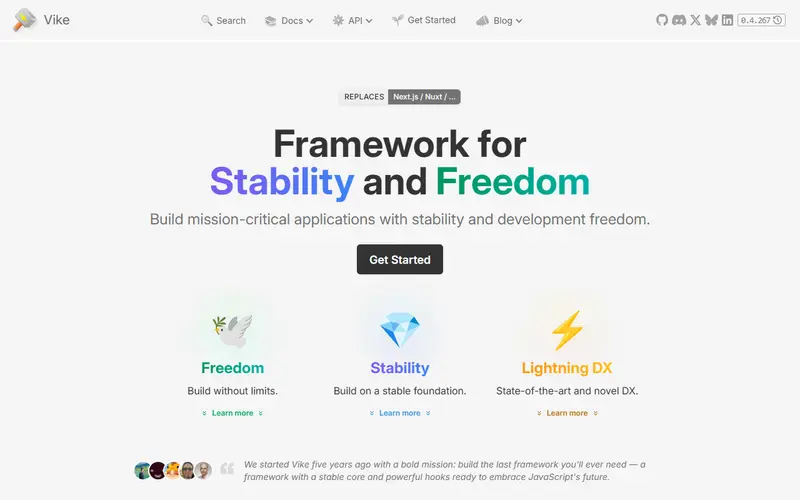
Vite-based framework with a stable hook-based core that works with React, Vue, Solid and others, any backend and any host, and plans a pay-what-size licence for larger companies.
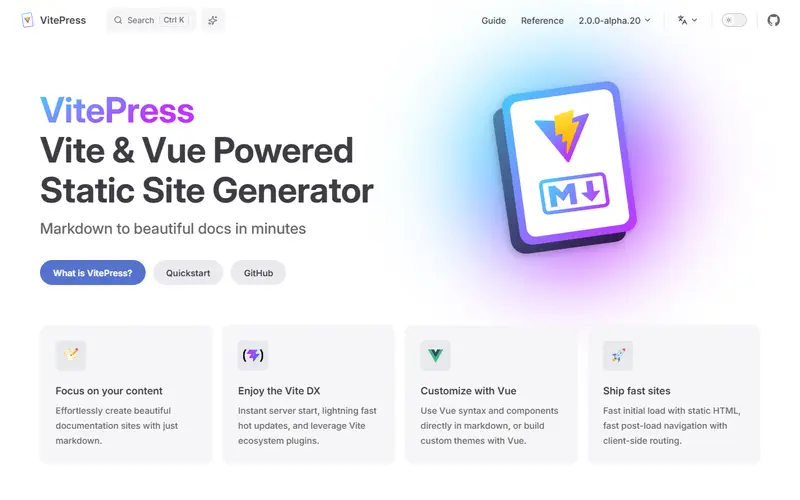
Vue- and Vite-powered static site generator built for technical documentation: Markdown in, static HTML out, then SPA navigation; powers the Vite, Vitest and Vue docs.
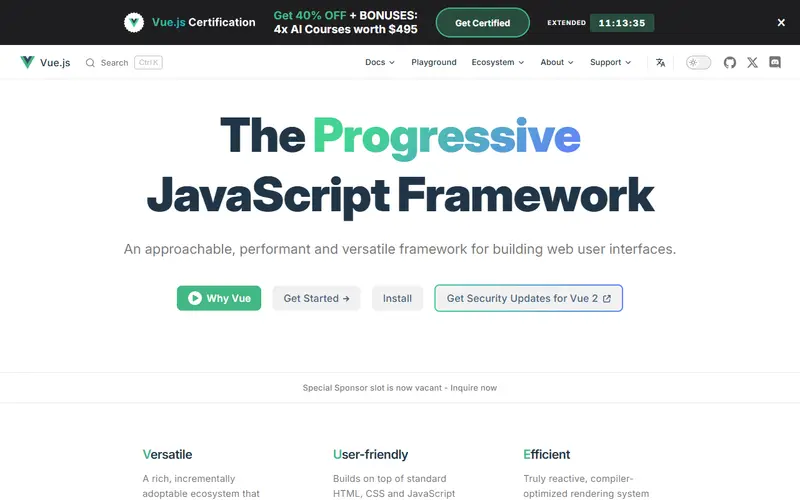
Independent, MIT-licensed UI framework with HTML-based templates and automatic reactivity that scales from sprinkling onto a static page to SPAs, SSR and static sites.
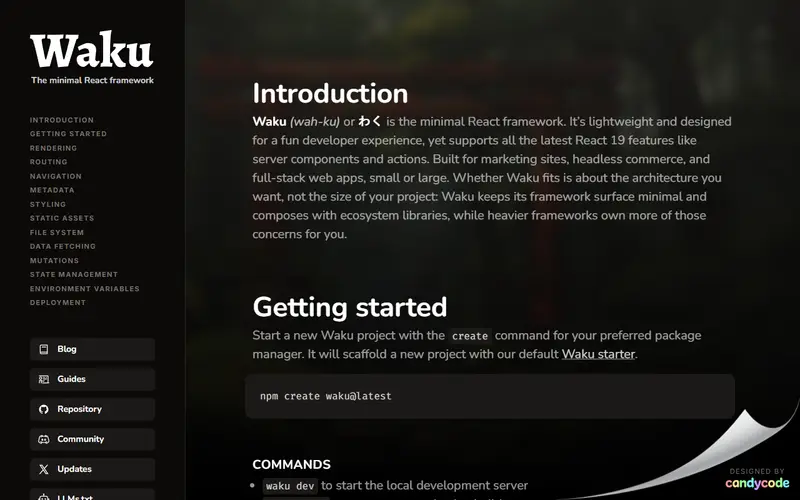
Minimal React framework designed around Server Components from the start, built on Vite and Hono, where each route can be static, dynamic or a blend; 1.0 reached release candidate in August 2026.
| Tool | Pricing | UI library | Rendering | Deploys to | Maintained by |
|---|---|---|---|---|---|
| Analog analogjs.org · OSS | Open source | Angular | SSR, SSG, hybrid | Node server default; Nitro presets for other hosts | Community (Brandon Roberts), sponsors |
| Angular angular.dev · OSS | Open source | Own (Angular components, signals) | CSR default; SSR, prerender (SSG), hybrid per route | Static for CSR/SSG; Node server for SSR | |
| Astro astro.build · OSS | Open source | Own (.astro) plus React, Vue, Svelte, Solid, Preact | SSG default, SSR per route, islands, server islands | Static anywhere; adapters: Node, Cloudflare, Vercel, Netlify | Cloudflare (Astro team acquired Jan 2026) |
| Docusaurus docusaurus.io · OSS | Open source | React (MDX) | SSG with SPA navigation | Any static host | Meta Open Source |
| Eleventy (Build Awesome) 11ty.dev · OSS | Open source | None (templates: Markdown, Nunjucks, Liquid, WebC, JSX) | SSG | Any static host | Font Awesome (Zach Leatherman leads) |
| Fresh usefresh.dev · OSS | Open source | Preact (islands) | SSR with islands; no SPA mode | Anywhere Deno runs; Deno Deploy, Docker | Deno (company) |
| Gatsby gatsbyjs.com · OSS | Open source | React | SSG, DSG, SSR | Static hosts; adapters (Netlify first) | Netlify (limited maintenance) |
| Hugo gohugo.io · OSS | Open source | None (Go templates) | SSG | Any static host; hugo deploy to cloud storage | Community (Hugo Authors, led by bep) |
| Leptos leptos.dev · OSS | Open source | Own (Rust, view! macro, signals) | SSR with WASM hydration, CSR | Rust server binary, or static files for CSR | Community (Greg Johnston), sponsors |
| Next.js nextjs.org · OSS | Open source | React | SSR, SSG, ISR, streaming, RSC, partial prerender | Any Node host or Docker; static export; adapters | Vercel |
| Nuxt nuxt.com · OSS | Open source | Vue | SSR, SSG, SPA, hybrid route rules, ISR | Any Node host, static, serverless/edge via Nitro presets | NuxtLabs, part of Vercel since July 2025 |
| Qwik qwik.dev · OSS | Open source | Own (JSX, React-like syntax) | SSR with resumability, SSG, lazy loading | Adapters: Node/Express, Cloudflare, Netlify, Vercel, Deno | QwikDev community; created by Builder.io engineers |
| React react.dev · OSS | Open source | React | CSR; SSR, RSC and streaming via frameworks | Static host for SPA; server rendering via a framework | React Foundation (Linux Foundation) since Feb 2026 |
| React Router (framework mode) reactrouter.com · OSS | Open source | React | SSR, SPA, static prerender, streaming; RSC preview | Node, Cloudflare and other templates; static SPA | Shopify (Remix team), open governance |
| RedwoodSDK rwsdk.com · OSS | Open source | React (Server Components) | SSR, RSC, streaming, realtime | Cloudflare Workers only (workerd) | Redwood team (successor to RedwoodJS) |
| Remix 3 remix.run · OSS | Open source | Own UI runtime (JSX, no React) | Server rendering, Frames, SPA mode | Fetch-based servers on modern JS runtimes | Shopify (Remix team) |
| SolidStart docs.solidjs.com · OSS | Open source | Solid | CSR, SSR (sync, async, streaming), SSG | Nitro presets: Node, Netlify, Vercel, AWS, Cloudflare | Solid core team (community); being retired for Solid 2.0 |
| Starlight starlight.astro.build · OSS | Open source | Astro (use React, Vue, Svelte etc. as islands) | SSG (Astro), islands | Any static host; Astro adapters for SSR | Astro team at Cloudflare |
| SvelteKit svelte.dev · OSS | Open source | Svelte | SSR, CSR, prerender (SSG), per route | Adapters: Node, static, Vercel, Netlify, Cloudflare | Svelte core team (community, volunteer-funded) |
| TanStack Start tanstack.com · OSS | Open source | React; Solid (beta) | SSR, streaming, SPA, static prerender; RSC experimental | Cloudflare, Netlify, Railway, Vercel, Node, Bun, Nitro | TanStack LLC (bootstrapped) and sponsors |
| Vike vike.dev · OSS | Open source | React, Vue, Solid, Angular and others via extensions | SPA, SSR, SSG per page; HTML streaming | Self-host, Cloudflare, Vercel, AWS, Netlify, Google Cloud | Independent Vike team, no investors |
| VitePress vitepress.dev · OSS | Open source | Vue | SSG, then SPA navigation | Any static host | Vue team (Evan You), sponsored by VoidZero |
| Vue vuejs.org · OSS | Open source | Vue | CSR/SPA; SSR and SSG via Nuxt or VitePress | Static host for SPA; Node for SSR (usually via Nuxt) | Independent core team, sponsors |
| Waku waku.gg · OSS | Open source | React (Server Components) | RSC, static per route, dynamic SSR, blended slices | Node (waku start), static output, Cloudflare and others | Community, led by Daishi Kato |
No tools match these filters.
How to choose a framework
- Start from the UI library you or your AI assistant know (React, Vue, Svelte, Solid): the framework on top matters less than that choice.
- Content sites (blogs, docs, marketing) suit frameworks that ship little JavaScript by default, such as Astro. Apps with sign-in and dashboards suit full-stack frameworks such as Next.js, Nuxt or SvelteKit.
- Check where it deploys. Most run on any Node host or as static files; some features work best, or only, on the maintainer’s own hosting.
- Look at who maintains it and how often it ships breaking major versions; a framework is hard to leave once your app is built on it.
Questions
Which web framework should a beginner use?
Pick the one your tutorials and AI assistant use most, which today usually means Next.js for apps and Astro for content sites. Both are free, well documented and deploy to most hosts.
Do I need a framework at all?
Not for a few static pages. Once you have several pages sharing a layout, data from an API or a database, or users signing in, a framework saves you from writing routing and build tooling yourself.