Skip to content
whichdevtool?
Categories ▾

Frameworks and UI

Frontend and full-stack frameworks Backend frameworks UI component libraries

Hosting

VPS and cloud servers App hosting and PaaS

Data

Managed databases File and object storage ORMs and database toolkits

AI

AI model APIs

Email

Transactional email APIs Email marketing and newsletters

Payments

Payments and billing

Domains and edge

Domain registrars CDN, DNS and edge security

Operations and identity

Monitoring, uptime and error tracking Auth and identity Background jobs, queues and workflows
Stacks Directory
Ctrl K

Search directory
Menu
StacksDirectory Pricing changes Glossary
VPS and cloud servers App hosting and PaaS Managed databases Transactional email APIs Email marketing and newsletters Domain registrars CDN, DNS and edge security Monitoring, uptime and error tracking Auth and identity Frontend and full-stack frameworks Backend frameworks UI component libraries AI model APIs File and object storage Payments and billing Background jobs, queues and workflows ORMs and database toolkits
  1. Home
  2. Frontend and full-stack frameworks
  3. React

UI library · by React Foundation (Linux Foundation)

React

The most used JavaScript UI library, now owned by the React Foundation under the Linux Foundation; react.dev recommends starting new apps with a framework such as Next.js or React Router.

Visit react.dev ↗ Alternatives Open source Open source Self-hostable
react.dev
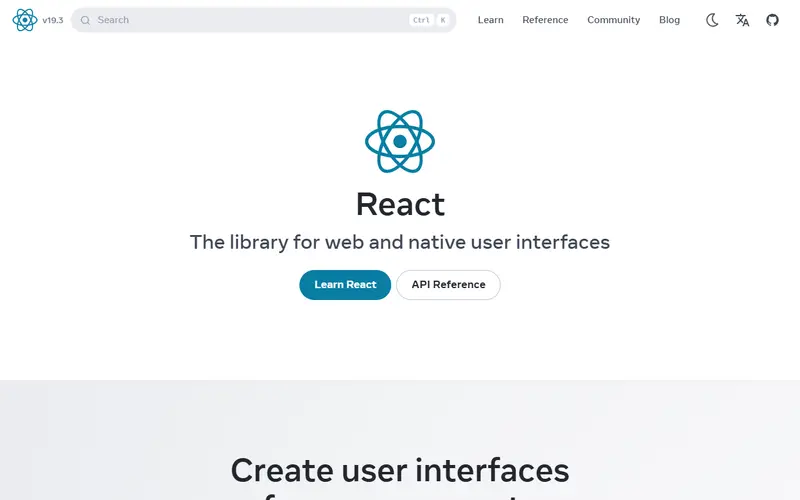
React homepage
§1

Overview

React is a library for building UIs from components. On its own it renders in the browser; features such as server rendering, React Server Components and Server Functions are defined by React but delivered through frameworks and bundlers. That is why react.dev's own advice is to start new apps with a framework: it lists Next.js (App Router), maintained by Vercel, and React Router v7, maintained by Shopify, and notes that these frameworks also support client-only SPAs and static sites.

If a framework does not fit, the docs explain how to build a React app from scratch with a build tool such as Vite, Parcel or Rsbuild. Create React App was deprecated for new apps on 14 February 2025.

Governance changed in 2026. Announced in October 2025, the React Foundation launched on 24 February 2026 under the Linux Foundation; React, React Native and JSX are no longer owned by Meta. Founding platinum members include Amazon, Callstack, Expo, Huawei, Meta, Microsoft, Software Mansion and Vercel. Security is worth watching when you use server features: in December 2025 React disclosed a CVSS 10.0 remote code execution flaw in React Server Components (CVE-2025-55182), patched in 19.0.1, 19.1.2 and 19.2.1.

§2

Pricing and plans

React is free and MIT-licensed. Costs depend on the framework and host you choose.

Source: react.dev/learn/creating-a-react-app · prices as published, excluding tax.

§3

What it does

Components and hooks
UI built from function components with state and effects via hooks.
Server Components
Components that render only on the server, available through supporting frameworks.
Server Functions
Functions called from the client and run on the server, wired up by the framework.
React Compiler
Automatic memoisation, integrated in frameworks such as Next.js 16.
§4

Strengths and limitations

Strengths

  • Largest ecosystem of libraries, component kits and developers.
  • Neutral foundation governance since February 2026 with many corporate members.
  • Choice of frameworks (Next.js, React Router, TanStack Start, Waku) and plain SPAs.

Limitations

  • Not a full framework: routing, data loading and server rendering come from a framework you pick.
  • Create React App is deprecated; new projects need a framework or a build tool such as Vite.
  • Server Components widen the server attack surface; the December 2025 RSC flaw was rated CVSS 10.0.
§5

Who it suits

Good for

  • Any team that wants the largest UI ecosystem
  • SPAs built with Vite
  • Apps that will adopt a React framework

Look elsewhere if

  • Content sites that should ship almost no JavaScript without a framework like Astro
  • Teams wanting one opinionated, all-in-one framework
§6

Pricing history

  • 24 Feb 2026

    React moves to the React Foundation

    Launched 24 February 2026 (announced October 2025): React, React Native and JSX are now owned by the React Foundation under the Linux Foundation instead of Meta. Source ↗

  • 3 Dec 2025

    Critical React Server Components vulnerability

    Disclosed 3 December 2025: CVE-2025-55182 (CVSS 10.0) allowed unauthenticated remote code execution through React Server Function endpoints. Fixed in React 19.0.1, 19.1.2 and 19.2.1; next, react-router, waku and rwsdk were listed as affected. Source ↗

  • 14 Feb 2025

    Create React App deprecated

    Announced 14 February 2025: the React team deprecated Create React App for new apps and now recommends starting with a framework (Next.js, React Router) or a build tool such as Vite, Parcel or Rsbuild. Source ↗

§7

Alternatives to React

Tool From Free option Stages
Docusaurus Documentation site generator (React)
— Open source
Vue Progressive UI framework
— Open source
Next.js Full-stack React framework
— Open source
Astro Content-focused web framework
— Open source
Nuxt Full-stack Vue framework
— Open source
Hugo Static site generator (Go)
— Open source

All frontend and full-stack frameworks →

§8

Questions

Who owns React now?

The React Foundation, hosted by the Linux Foundation, since 24 February 2026; Meta contributed the project and remains a member.

Is Create React App deprecated?

Yes. The React team deprecated it for new apps on 14 February 2025 and recommends a framework or a build tool like Vite, Parcel or Rsbuild.

Which React framework does react.dev recommend?

It lists Next.js (App Router) and React Router v7 as full-stack frameworks, plus Expo for native apps.

Sources read for this page

  • https://react.dev/learn/creating-a-react-app
  • https://react.dev/blog/2025/02/14/sunsetting-create-react-app
  • https://react.dev/blog/2025/10/07/introducing-the-react-foundation
  • https://react.dev/blog/2026/02/24/the-react-foundation
  • https://www.linuxfoundation.org/press/linux-foundation-announces-the-formation-of-the-react-foundation
  • https://react.dev/blog/2025/12/03/critical-security-vulnerability-in-react-server-components
Spec sheet
From
Open source
Free tier
Free to self-host
Stages
HobbyIndieStartupScale-upEnterprise Suits hobby, indie, startup, scale-up, enterprise
UI library
React
Rendering
CSR; SSR, RSC and streaming via frameworks
Deploys to
Static host for SPA; server rendering via a framework
Maintained by
React Foundation (Linux Foundation) since Feb 2026
Open source
Yes
Self-host
Yes
EU data
Not stated
Category
Frameworks
Visit react.dev ↗

To report an out-of-date price or limit, use the correction form.

whichdevtool?

Developer and cloud tools compared on price, free tier and limits, each with its source. For side projects, solo developers and small teams.

Categories

  • VPS and cloud servers
  • App hosting and PaaS
  • Managed databases
  • Transactional email APIs
  • Email marketing and newsletters
  • Domain registrars
  • CDN, DNS and edge security
  • Monitoring, uptime and error tracking
  • Auth and identity
  • Frontend and full-stack frameworks
  • Backend frameworks
  • UI component libraries
  • AI model APIs
  • File and object storage
  • Payments and billing
  • Background jobs, queues and workflows
  • ORMs and database toolkits

Research

  • Directory
  • Stacks by project
  • Developer news
  • Pricing changes
  • Glossary

Site

  • About and methods
  • How we make money
  • Suggest a tool or fix
  • Privacy
© 2026 whichdevtool.com Prices change. Each tool page links to its source. We may earn a commission when you sign up through links on this site. How we make money