Overview
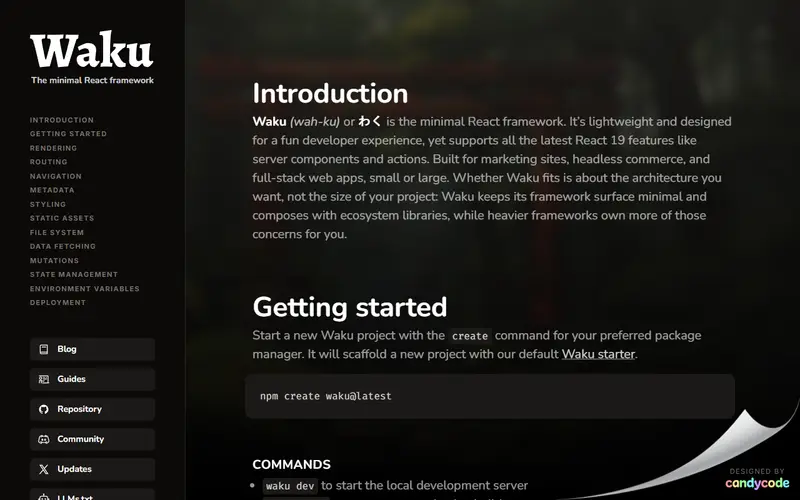
Waku (wah-ku) describes itself as the minimal React framework. It was designed around React Server Components from its first release in 2023 and supports React 19 features such as server components and actions. Server components can be async and access databases or the file system; client components opt in with 'use client'; and shared components work on either side.
Each route is composed of layouts, slices and a page, and each piece has its own render config, so a page can be fully static, fully dynamic or a mix. The project says it fits marketing sites, blogs, docs and light e-commerce, but that the real question is architecture: Waku keeps its own surface small and leaves concerns like data and styling to libraries, whereas larger frameworks own more of them. It supports file-based and config-based routing.
Waku runs on Vite and Hono. The 1.0 alpha (December 2025) froze the public API, the beta (May 2026) added graceful version-skew handling and Vite 8, and the release candidate on 25 August 2026 fixed public APIs and explicitly marks unstable ones. It requires a recent Node.js (22.15+, 24 or 26). Like other RSC frameworks, it was listed among packages affected by the December 2025 React Server Components vulnerability.
Pricing and plans
What it does
- Server Components first
- Async server components with server actions; client components marked with 'use client'.
- Per-segment rendering
- Layouts, slices and pages each set static or dynamic rendering.
- File or config routing
- File-based routing, or programmatic config-based routes.
- Vite and Hono
- Vite dev server and builds; Hono-based server.
- Version-skew handling
- Clients loaded against an old build recover after a redeploy (since the 1.0 beta).
Strengths and limitations
Strengths
- Small API surface that makes Server Components easier to learn.
- Static and dynamic rendering can be mixed within a single route.
- Composes with ecosystem libraries instead of prescribing them.
Limitations
- 1.0 is a release candidate, not a final release, at the time of writing.
- React-only and built around Server Components, which carry their own learning curve and security exposure.
- Requires Node.js 22.15+, 24 or 26.
- Deliberately minimal: auth, data and other concerns are left to you and third-party libraries.
Who it suits
Good for
- Learning React Server Components
- Mostly static sites with some dynamic routes
- Developers who want a light alternative to Next.js
Look elsewhere if
- Teams that want an all-in-one framework with many built-in integrations
- Projects that must avoid pre-1.0 dependencies
Pricing history
-
Waku 1.0 release candidate
Released 25 August 2026: public APIs are fixed and unstable APIs explicitly marked, following the 1.0 alpha (December 2025) and beta (May 2026). Source ↗
Alternatives to Waku
Questions
Is Waku production ready?
Waku 1.0 reached release candidate on 25 August 2026 with fixed public APIs; the final 1.0 had not shipped at the time of writing.
How is Waku different from Next.js?
Both use React Server Components, but Waku keeps a minimal framework surface and composes with libraries, while Next.js owns more concerns such as caching and image handling.
Which Node.js version does Waku need?
Node.js ^22.15.0, ^24.0.0 or ^26.0.0.
Sources read for this page