Overview
RedwoodJS, the full-stack React and GraphQL framework, changed direction in April 2025. The team split its work into Redwood GraphQL, the existing framework, which continues to get maintenance releases without new features planned, and RedwoodSDK, a new framework where development now happens. The Redwood blog says RedwoodJS apps remain supported but recommends RedwoodSDK for new projects.
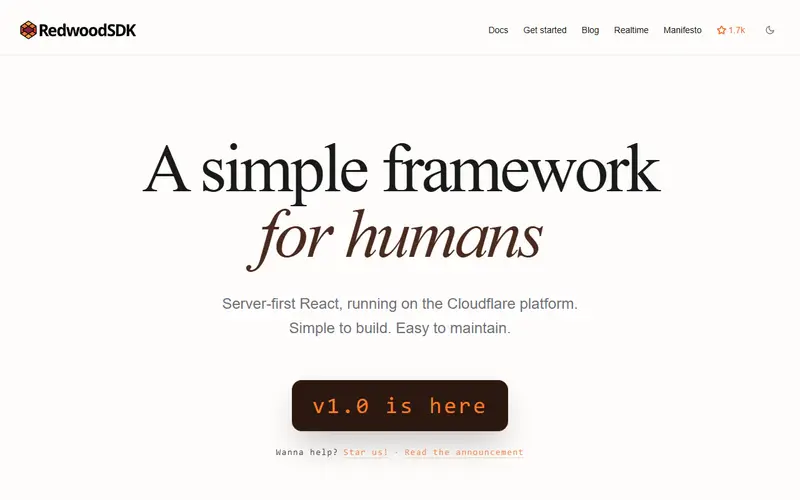
RedwoodSDK is a server-first React framework for Cloudflare. It begins as a Vite plugin enabling server-side rendering, React Server Components, server functions and streaming, and adds a type-safe, web-standards router with middleware. It avoids code generation and implied routing: routes are plain TypeScript functions. A useSyncedState hook synchronises state across connected clients in real time without writing WebSocket handlers.
The trade-off is lock-in by design: the repository says it runs on Cloudflare (workerd) only, and local development uses Miniflare to emulate Workers, D1, R2, Queues and Durable Objects. RedwoodSDK 1.0 entered beta in October 2025. Like other RSC frameworks, its package (rwsdk) was listed as affected by the December 2025 React Server Components vulnerability.
Pricing and plans
What it does
- Vite plugin
- Starts as a Vite plugin; no custom build tool.
- Server Components and server functions
- Async server components, server actions and streaming responses.
- Standards-based router
- Type-safe routes as functions, with middleware and interrupters for request control.
- Realtime state
- useSyncedState synchronises state across all connected clients.
- Cloudflare bindings locally
- Miniflare gives D1, R2, Queues and Durable Objects in local development.
Strengths and limitations
Strengths
- Direct access to Cloudflare's database, storage and realtime primitives.
- No code generation or hidden routing conventions.
- Local development mirrors production through Miniflare.
Limitations
- Runs on Cloudflare Workers only; you cannot deploy it to a generic Node host.
- Young framework: 1.0 entered beta in October 2025.
- Not a drop-in upgrade for RedwoodJS apps; the old framework continues as Redwood GraphQL.
- Server Components expose it to RSC security issues such as CVE-2025-55182 (December 2025).
Who it suits
Good for
- Full-stack React apps committed to Cloudflare
- Realtime collaborative apps using Durable Objects
- Small teams that want few abstractions
Look elsewhere if
- Apps that must run on AWS, a VPS or any Node host
- Existing RedwoodJS GraphQL apps expecting an in-place upgrade
Pricing history
-
RedwoodJS splits into Redwood GraphQL and RedwoodSDK
Announced 4 April 2025: the original RedwoodJS framework continues as Redwood GraphQL with maintenance but no new features planned, while new development moves to RedwoodSDK, a React framework that runs only on Cloudflare. Source ↗
Alternatives to RedwoodSDK
| Tool | From | Free option | Stages |
|---|---|---|---|
| Nuxt Full-stack Vue framework | — | ||
| VitePress Static site generator (Vue, Vite) | — | ||
| SolidStart Full-stack Solid framework | — | ||
| Analog Full-stack Angular meta-framework | — | ||
| Vue Progressive UI framework | — | ||
| TanStack Start Full-stack React (and Solid) framework | — |
Questions
What happened to RedwoodJS?
In April 2025 it became Redwood GraphQL, which stays maintained without new features planned, while new framework work moved to RedwoodSDK.
Can RedwoodSDK run outside Cloudflare?
No. Its repository states it is for Cloudflare's workerd runtime only.
Does RedwoodSDK use React Server Components?
Yes. It enables RSC, server functions and streaming through its Vite plugin.
Sources read for this page