Overview
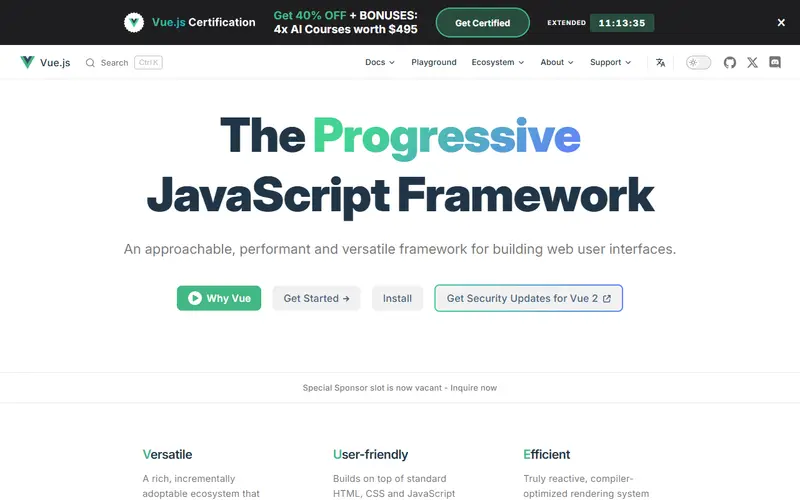
Vue calls itself the progressive framework: it can enhance static HTML without a build step, embed as web components, power a single-page app, or render on the server and at build time. Its two core ideas are declarative rendering with a template syntax that extends HTML, and a reactivity system that updates the DOM automatically when JavaScript state changes.
Most projects use single-file components (.vue files holding template, script and style) built with Vite, which also comes from the Vue ecosystem. You can write components with the Options API or the Composition API. Official companions cover routing (Vue Router) and state (Pinia), and full-stack needs such as SSR, file routing and server routes are usually handled by Nuxt, while VitePress covers documentation sites.
The docs you read today are for Vue 3; Vue 2 support ended on 31 December 2023. On its own Vue is a client-side UI framework, so for this category's comparison think of it as the base that Nuxt, VitePress and Vike build on.
Pricing and plans
What it does
- Template syntax
- HTML-based templates with directives; valid HTML stays valid Vue.
- Reactivity
- Automatic dependency tracking with ref and reactive; no manual memoisation.
- Single-file components
- .vue files combine template, logic and scoped styles.
- Options and Composition APIs
- Two styles for writing components; both are supported.
- No-build usage
- Can be loaded from a script tag to enhance existing pages.
Strengths and limitations
Strengths
- Gentle learning curve for people who know HTML, CSS and JavaScript.
- Official router, state and build tooling reduce library shopping.
- Works for both small enhancements and full applications.
- Independent project not controlled by a single large company.
Limitations
- Vue alone is client-side; SSR, file routing and server routes come from Nuxt or another meta-framework.
- Vue 2 is end of life since 31 December 2023, so older apps need migration to Vue 3.
- Two component-authoring APIs mean examples and libraries use different styles.
Who it suits
Good for
- SPAs and admin panels
- Adding interactivity to server-rendered pages
- Teams that prefer templates over JSX
Look elsewhere if
- Teams that need a full-stack framework out of the box (use Nuxt)
- React-only component ecosystems
Alternatives to Vue
Questions
Is Vue 2 still supported?
No. Vue 2 support ended on 31 December 2023; the official docs point to a migration guide for Vue 3.
Do I need Nuxt to use Vue?
No. Vue works on its own for SPAs or page enhancements; Nuxt adds SSR, file routing and server routes.
Can Vue run without a build step?
Yes. It can be loaded directly in the browser to enhance static HTML.
Sources read for this page