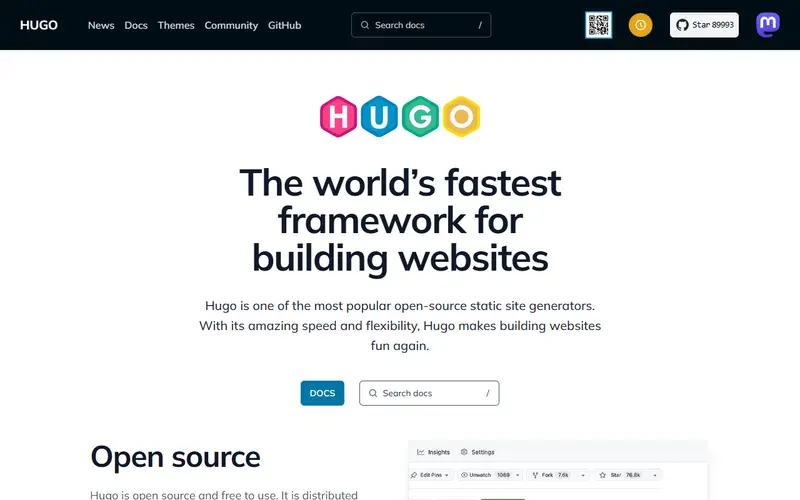
Overview
Hugo is a static site generator written in Go, first published in 2013 and still actively developed, with Bjorn Erik Pedersen (bep) as the main contributor alongside creator Steve Francia and many others. It is optimised for speed: the project says a complete site renders in seconds, often less. Because it ships as a single binary, there is no npm install or Node.js version to manage.
Content is Markdown with front matter, and layouts use Go's template language. Built in are a taxonomy system, multilingual sites, image processing, asset pipelines including Dart Sass transpilation, and an embedded development server with live reload. Hugo Modules let you share content, assets, data, translations, themes and templates between projects through public or private Git repositories.
Common uses listed by the project include corporate, government and nonprofit sites, documentation, portfolios, landing pages, blogs and resumes. Deploy by uploading the public folder to any host, pushing to a Git-connected platform, or using hugo deploy to publish to cloud storage.
Pricing and plans
What it does
- Single binary
- No runtime dependencies for the core; install one executable for Linux, macOS, Windows or BSD.
- Fast builds
- Designed to render complete sites in seconds or less.
- Multilingual and taxonomies
- First-class multiple languages and custom taxonomies such as tags and categories.
- Asset pipelines
- Image processing, bundling and Sass transpilation built in.
- Hugo Modules
- Share themes, content and configuration across projects via Git.
Strengths and limitations
Strengths
- Very fast builds, even for sites with thousands of pages.
- Nothing to install beyond one binary; stable for long-lived sites.
- Large theme gallery and long track record.
Limitations
- Go templates are unfamiliar to many web developers and less flexible than JavaScript components.
- Static output only; no server-side rendering per request.
- No built-in JavaScript component framework for interactive parts.
- Some features, such as Dart Sass transpilation, need extra tools installed alongside the binary.
Who it suits
Good for
- Documentation and large content sites
- Multilingual sites
- Teams that want no Node.js toolchain
Look elsewhere if
- Interactive web apps
- Teams that want to build pages from React or Vue components
Alternatives to Hugo
| Tool | From | Free option | Stages |
|---|---|---|---|
| Docusaurus Documentation site generator (React) | — | ||
| Astro Content-focused web framework | — | ||
| React UI library | — | ||
| Vue Progressive UI framework | — | ||
| Next.js Full-stack React framework | — | ||
| React Router (framework mode) React router and full-stack framework | — |
Questions
Does Hugo need Node.js?
No. Hugo is a single Go binary; some optional features such as Dart Sass need extra tools.
What licence does Hugo use?
Apache License 2.0.
Where can I host a Hugo site?
Anywhere that serves static files: object storage, a CDN, a VPS with nginx, or Git-connected static hosts.
Sources read for this page