Overview
Gatsby was one of the first popular React frameworks for static sites. Its distinguishing feature is a GraphQL data layer that pulls content from CMSs, Markdown, e-commerce platforms and APIs into one queryable graph, backed by thousands of plugins. It also offers SSR and deferred static generation (DSG).
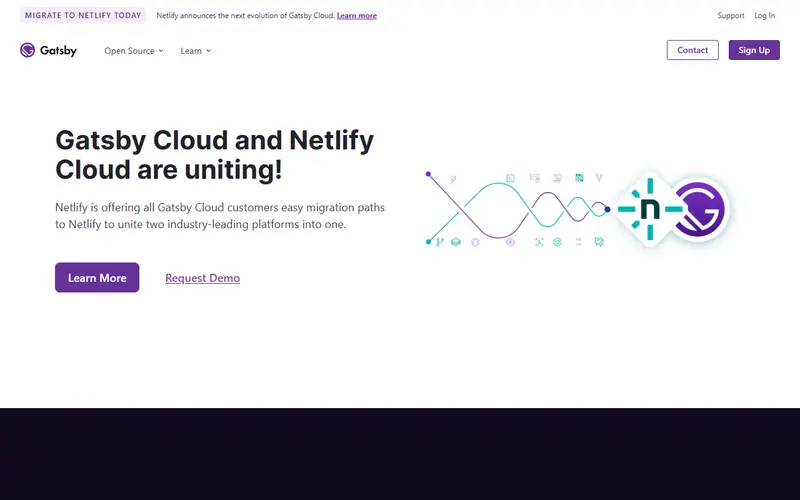
Netlify acquired Gatsby in February 2023 and later ended Gatsby Cloud, stating the framework would continue with a focus on stability rather than new rendering paradigms. In the project's GitHub discussions a Netlify maintainer describes the current approach as limited development: security fixes, limited dependency updates, low-hanging bug fixes and handling third-party API deprecations. Community threads there openly ask whether Gatsby is dead.
Releases continue at that level. Gatsby 5.15 (August 2025) added Node.js 22 support; 5.16 (January 2026) added official React 19 support for Gatsby-maintained packages, though partial hydration is incompatible with React 19 and community plugins may lag. For an existing Gatsby site this means you can keep running and patching it; for a new project, Astro, Next.js or Eleventy are safer long-term choices.
Pricing and plans
What it does
- GraphQL data layer
- Query content from many sources through one GraphQL schema at build time.
- Plugin ecosystem
- Source, transformer and utility plugins, some maintained by the Gatsby team.
- Rendering options
- Static generation, deferred static generation and server-side rendering.
- Adapters
- Adapters decouple deployment from Gatsby Cloud; Netlify's is maintained.
Strengths and limitations
Strengths
- Mature for existing sites, with React 19 and Node.js 22/24 support added in 2025-2026.
- Data layer still useful for sites pulling from many content sources.
- Static output deploys to any host.
Limitations
- In limited maintenance: security and compatibility fixes only, no roadmap for new features, per Netlify maintainers on GitHub.
- Community plugins may not support React 19 yet; only plugins in the gatsbyjs/gatsby repository were updated, per the 5.16 release notes.
- Partial hydration is incompatible with React 19; React 19's document metadata hoisting is disabled.
- Gatsby Cloud was shut down; hosting outside Netlify relies on adapters and community effort.
Who it suits
Good for
- Keeping an existing Gatsby site running and patched
Look elsewhere if
- New projects of any size
- Teams that need modern React features such as Server Components
Pricing history
-
Gatsby 5.16 adds React 19 support
Released 26 January 2026: official React 19 support for Gatsby-maintained packages, within Netlify's limited-maintenance approach; partial hydration remains incompatible with React 19. Source ↗
Alternatives to Gatsby
| Tool | From | Free option | Stages |
|---|---|---|---|
| Hugo Static site generator (Go) | — | ||
| Vue Progressive UI framework | — | ||
| Eleventy (Build Awesome) Static site generator | — | ||
| Docusaurus Documentation site generator (React) | — | ||
| Leptos Full-stack Rust web framework | — | ||
| Waku Minimal React Server Components framework | — |
Questions
Is Gatsby dead?
Not officially, but Netlify maintains it at a limited level: security fixes, dependency updates and compatibility, with no new-feature roadmap.
Does Gatsby support React 19?
Yes, since Gatsby 5.16 (January 2026) for Gatsby-maintained packages; partial hydration does not work with React 19.
What should I migrate a Gatsby site to?
Astro suits content sites, Next.js suits React apps, and Eleventy suits simple static sites; choose by how much interactivity you need.
Sources read for this page