Skip to content
whichdevtool?
Categories ▾

Frameworks and UI

Frontend and full-stack frameworks Backend frameworks UI component libraries

Hosting

VPS and cloud servers App hosting and PaaS

Data

Managed databases File and object storage ORMs and database toolkits

AI

AI model APIs

Email

Transactional email APIs Email marketing and newsletters

Payments

Payments and billing

Domains and edge

Domain registrars CDN, DNS and edge security

Operations and identity

Monitoring, uptime and error tracking Auth and identity Background jobs, queues and workflows
Stacks Directory
Ctrl K

Search directory
Menu
StacksDirectory Pricing changes Glossary
VPS and cloud servers App hosting and PaaS Managed databases Transactional email APIs Email marketing and newsletters Domain registrars CDN, DNS and edge security Monitoring, uptime and error tracking Auth and identity Frontend and full-stack frameworks Backend frameworks UI component libraries AI model APIs File and object storage Payments and billing Background jobs, queues and workflows ORMs and database toolkits
  1. Home
  2. Frontend and full-stack frameworks
  3. Leptos
Le

Full-stack Rust web framework · by Leptos community (Greg Johnston)

Leptos

Rust framework for full-stack web apps with fine-grained reactive signals, server-side rendering, WebAssembly hydration and #[server] functions that cross the client-server boundary.

Visit leptos.dev ↗ Alternatives Open source Open source Self-hostable
leptos.dev
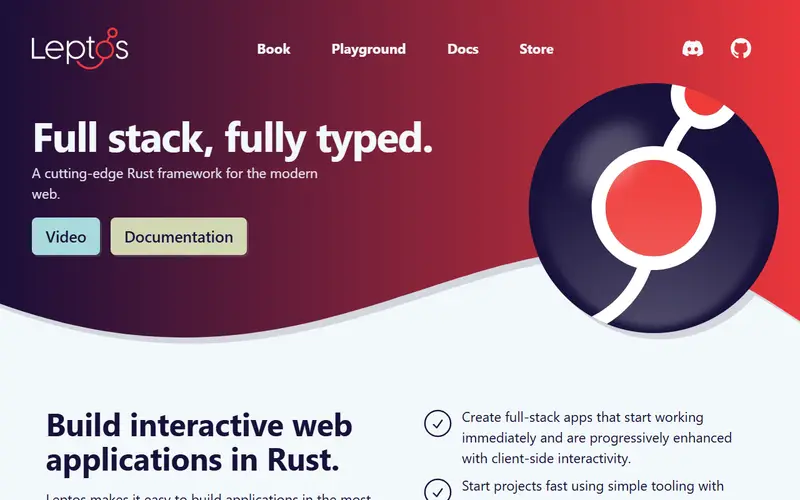
Leptos homepage
§1

Overview

Leptos is a web framework for Rust, developed in the open since July 2022 by Greg Johnston (gbj) and hundreds of contributors. Components return views built with a JSX-like view! macro or a builder syntax, and state lives in fine-grained reactive signals, so updates touch only the DOM nodes that depend on changed values rather than re-rendering components.

For full-stack apps, pages render on the server and are progressively enhanced with client-side interactivity compiled to WebAssembly. #[server] functions let a component call backend code, such as a SQL query, without writing an API endpoint by hand. Apps can also run client-side only.

Deployment means shipping a Rust server binary plus the WASM and static assets. The Leptos book stresses always building in --release mode, testing release builds locally because some optimisations only apply there, and optimising WASM binary size to keep time-to-interactive down. The latest line was 0.9 in beta (July 2026), so the API still changes between minor versions.

§2

Pricing and plans

Free and MIT-licensed; you host the compiled server binary or static WASM bundle yourself.

Source: book.leptos.dev/deployment/index.html · prices as published, excluding tax.

§3

What it does

Fine-grained signals
Reactive signals update exactly the affected DOM nodes.
Server functions
#[server] functions run on the server and are called like normal functions from the client.
SSR with hydration
Server-rendered HTML that hydrates via WebAssembly for interactivity.
view! macro
JSX-like templates in Rust, or a builder syntax.
Type safety end to end
Rust types shared between server and client code.
§4

Strengths and limitations

Strengths

  • One language and type system across frontend and backend.
  • Fine-grained reactivity avoids virtual-DOM overhead.
  • Active community with a published book, examples and awesome-leptos list.

Limitations

  • Pre-1.0: versions such as 0.9 bring breaking changes.
  • WASM bundles need size optimisation for good time-to-interactive, per the Leptos book.
  • Release and debug builds can behave differently; the book advises testing release builds locally before deploying.
  • Much smaller ecosystem of UI components and hosting integrations than JavaScript frameworks.
§5

Who it suits

Good for

  • Rust teams building full-stack web apps
  • Apps that want shared types between server and client
  • Performance-sensitive interactive UIs

Look elsewhere if

  • Teams without Rust experience
  • Content sites where a static generator is simpler
§6

Alternatives to Leptos

Tool From Free option Stages
React Router (framework mode) React router and full-stack framework
— Open source
Next.js Full-stack React framework
— Open source
TanStack Start Full-stack React (and Solid) framework
— Open source
Astro Content-focused web framework
— Open source
Nuxt Full-stack Vue framework
— Open source
Fr
Fresh Server-rendered web framework for Deno
— Open source

All frontend and full-stack frameworks →

§7

Questions

Can I build a full-stack app with Leptos?

Yes. Leptos supports server rendering, hydration and #[server] functions so backend and frontend code live in one Rust project.

How do I deploy a Leptos app?

Build in --release mode and run the server binary with the generated WASM and static assets on any host that runs Linux binaries or containers.

Is Leptos 1.0?

No. At the time of writing the latest release line was 0.9 in beta.

Sources read for this page

  • https://leptos.dev/
  • https://github.com/leptos-rs/leptos
  • https://book.leptos.dev/deployment/index.html
Spec sheet
From
Open source
Free tier
Free to self-host
Stages
HobbyIndieStartupScale-upEnterprise Suits hobby, indie, startup
UI library
Own (Rust, view! macro, signals)
Rendering
SSR with WASM hydration, CSR
Deploys to
Rust server binary, or static files for CSR
Maintained by
Community (Greg Johnston), sponsors
Open source
Yes
Self-host
Yes
EU data
Not stated
Category
Frameworks
Visit leptos.dev ↗

To report an out-of-date price or limit, use the correction form.

whichdevtool?

Developer and cloud tools compared on price, free tier and limits, each with its source. For side projects, solo developers and small teams.

Categories

  • VPS and cloud servers
  • App hosting and PaaS
  • Managed databases
  • Transactional email APIs
  • Email marketing and newsletters
  • Domain registrars
  • CDN, DNS and edge security
  • Monitoring, uptime and error tracking
  • Auth and identity
  • Frontend and full-stack frameworks
  • Backend frameworks
  • UI component libraries
  • AI model APIs
  • File and object storage
  • Payments and billing
  • Background jobs, queues and workflows
  • ORMs and database toolkits

Research

  • Directory
  • Stacks by project
  • Developer news
  • Pricing changes
  • Glossary

Site

  • About and methods
  • How we make money
  • Suggest a tool or fix
  • Privacy
© 2026 whichdevtool.com Prices change. Each tool page links to its source. We may earn a commission when you sign up through links on this site. How we make money