Overview
The Remix name has a complicated history. Remix v2 was a React framework; in 2024 its features merged into React Router v7, and the Remix team, which works at Shopify, announced in May 2025 that Remix 3 would be a fresh framework with no critical dependencies, not even React.
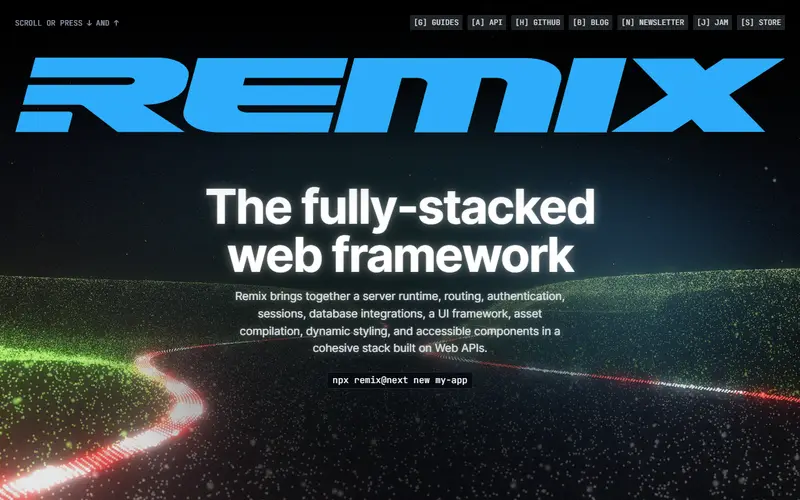
Remix 3 aims to be fully stacked rather than a routing and rendering layer. One remix package covers a fetch-based server runtime, typed routes, controllers and middleware, runtime validation and typed relational data for SQLite, PostgreSQL and MySQL with a database workflow (migrations, seeding, rollbacks) in the CLI, authentication, OAuth, sessions, streaming uploads with S3 integration, an unbundled asset server, a test framework and production server tooling. Its UI runtime uses JSX, but components run setup once and you call handle.update() to re-render, instead of hooks.
Timeline: beta preview on 30 April 2026, first release candidate on 31 August 2026, and the team says it will release Remix 3 on 2 October 2026 at Remix Jam. Packages can be used individually, and pieces such as the data layer can be swapped for Zod or Drizzle.
Pricing and plans
What it does
- Single-package full stack
- Server runtime, routing, data, auth, sessions, uploads, assets, UI and testing in one dependency.
- Database workflow
- Typed relational data for SQLite, PostgreSQL and MySQL with CLI migrations, seeding and rollbacks.
- Own UI runtime
- JSX components with plain JavaScript state and explicit updates; Frames for targeted navigation.
- Web APIs throughout
- Standard Request, Response, streams and File APIs across the stack.
- Composable packages
- Swap parts, e.g. use Zod or Drizzle instead of the built-in data packages.
Strengths and limitations
Strengths
- Few dependencies, which the team pitches as less npm supply-chain exposure.
- Covers database, auth and uploads that other meta-frameworks leave to third parties.
- Experienced team with a long record from React Router and Remix.
Limitations
- Release candidate at the time of writing; stable release planned for 2 October 2026.
- Not React: React component libraries do not work in its UI runtime without an adapter.
- Easy to confuse with Remix v2, whose users should move to React Router v7 instead.
- New ecosystem with few hosting guides, tutorials or third-party integrations yet.
Who it suits
Good for
- Greenfield full-stack apps where one team owns everything
- Developers who want web-standard APIs and fewer dependencies
Look elsewhere if
- Existing Remix v2 apps (upgrade to React Router v7)
- Teams that depend on React component libraries
- Production projects that must avoid pre-release software
Pricing history
-
Remix 3 release candidate
Released 31 August 2026: the first release candidate of the React-free Remix 3, with the stable release planned for 2 October 2026 at Remix Jam. Source ↗
-
Remix 3 will drop React
Announced 28 May 2025: after Remix v2 merged into React Router v7, the Remix team said Remix 3 would be a new framework with no critical dependencies, including React. Remix v2 users should upgrade to React Router v7. Source ↗
Alternatives to Remix 3
| Tool | From | Free option | Stages |
|---|---|---|---|
| Nuxt Full-stack Vue framework | — | ||
| TanStack Start Full-stack React (and Solid) framework | — | ||
| Hugo Static site generator (Go) | — | ||
| Docusaurus Documentation site generator (React) | — | ||
| Next.js Full-stack React framework | — | ||
| SvelteKit Full-stack Svelte framework | — |
Questions
Is Remix 3 based on React?
No. Remix 3 has its own JSX UI runtime; the React-based Remix lives on as React Router v7.
When is Remix 3 released?
The first release candidate shipped on 31 August 2026 and the team plans the release for 2 October 2026 at Remix Jam.
Should I upgrade my Remix v2 app to Remix 3?
No. The upgrade path for Remix v2 is React Router v7; Remix 3 is a different framework.
Sources read for this page