Skip to content
whichdevtool?
Categories ▾

Frameworks and UI

Frontend and full-stack frameworks Backend frameworks UI component libraries

Hosting

VPS and cloud servers App hosting and PaaS

Data

Managed databases File and object storage ORMs and database toolkits

AI

AI model APIs

Email

Transactional email APIs Email marketing and newsletters

Payments

Payments and billing

Domains and edge

Domain registrars CDN, DNS and edge security

Operations and identity

Monitoring, uptime and error tracking Auth and identity Background jobs, queues and workflows
Stacks Directory
Ctrl K

Search directory
Menu
StacksDirectory Pricing changes Glossary
VPS and cloud servers App hosting and PaaS Managed databases Transactional email APIs Email marketing and newsletters Domain registrars CDN, DNS and edge security Monitoring, uptime and error tracking Auth and identity Frontend and full-stack frameworks Backend frameworks UI component libraries AI model APIs File and object storage Payments and billing Background jobs, queues and workflows ORMs and database toolkits
  1. Home
  2. Frontend and full-stack frameworks
  3. SvelteKit

Full-stack Svelte framework · by Svelte core team

SvelteKit

The official Svelte application framework: file-based routing, per-route SSR, CSR or prerendering, and small adapters that target Node, static hosts, Vercel, Netlify or Cloudflare.

Visit svelte.dev ↗ Alternatives Open source Open source Self-hostable
svelte.dev
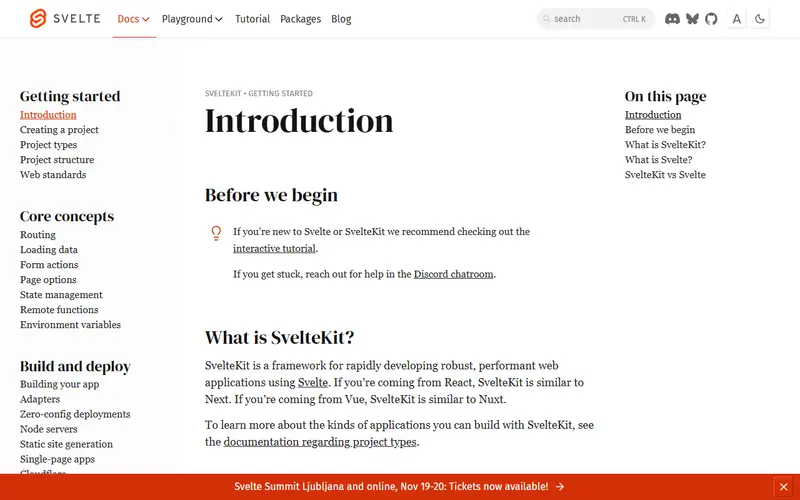
SvelteKit homepage
§1

Overview

SvelteKit is the application framework for Svelte, the compiler-based UI library. It adds file-based routing, load functions for data, form actions that work without JavaScript, hooks, server endpoints, preloading on hover, and configurable rendering per route: server-side rendering, client-side rendering or prerendering at build time. Development runs on Vite with hot module replacement.

Before deploying you pick an adapter, a small plugin run during vite build that turns the output into something a platform can run. Official adapters exist for Node servers, static site generation, Vercel, Netlify and Cloudflare Workers and Pages; adapter-auto detects common hosts, and the community maintains more.

SvelteKit has existed since 2020 and is maintained in the sveltejs organisation by the Svelte core team. The repository describes Svelte as an MIT-licensed project whose development is made possible by volunteers and Open Collective backers. Svelte's own components compile to small, framework-light JavaScript, which keeps bundles lean, but the ecosystem of third-party components is smaller than React's.

§2

Pricing and plans

SvelteKit is free and MIT-licensed. Hosting is billed by whichever platform the adapter targets; adapter-static output needs only a static host.

Source: svelte.dev/docs/kit/adapters · prices as published, excluding tax.

§3

What it does

Per-route rendering
Choose SSR, CSR or prerendering for each route, so one app can hold static pages and dynamic ones.
Load functions and form actions
Server and universal load functions fetch data; form actions handle POSTs with progressive enhancement.
Adapters
Official adapters for Node, static, Vercel, Netlify and Cloudflare; the adapter runs at build time.
Platform context
Adapters can pass platform objects, such as Cloudflare bindings, into hooks and server routes.
Vite-based tooling
Fast dev server with hot module replacement and access to the Vite plugin ecosystem.
§4

Strengths and limitations

Strengths

  • Small client bundles thanks to Svelte's compiler.
  • One codebase can deploy to a Node server, a static host or edge platforms by swapping the adapter.
  • Forms and navigation work before JavaScript loads (progressive enhancement).
  • Clear, compact documentation and an interactive tutorial.

Limitations

  • Svelte-only; you cannot drop in React or Vue components.
  • You must choose and configure an adapter before deploying; hosts without an official adapter depend on community packages.
  • Smaller component and hiring ecosystem than React or Vue.
  • Development funding relies on volunteers and Open Collective donations, per the project README, rather than a single sponsoring company.
§5

Who it suits

Good for

  • Solo developers and small teams who want less boilerplate
  • Apps and sites that need small bundles
  • Projects that may move between static and server hosting

Look elsewhere if

  • Teams committed to React or Vue component libraries
  • Organisations that need a large pool of framework-specific hires
§6

Alternatives to SvelteKit

Tool From Free option Stages
VP
VitePress Static site generator (Vue, Vite)
— Open source
Next.js Full-stack React framework
— Open source
React UI library
— Open source
Astro Content-focused web framework
— Open source
El
Eleventy (Build Awesome) Static site generator
— Open source
Vue Progressive UI framework
— Open source

All frontend and full-stack frameworks →

§7

Questions

What is the difference between Svelte and SvelteKit?

Svelte renders UI components; SvelteKit is the framework around it that adds routing, data loading, server rendering and deployment adapters.

Can SvelteKit build a static site?

Yes. Use @sveltejs/adapter-static to prerender the site for any static host.

How do I deploy SvelteKit to my own server?

Use @sveltejs/adapter-node, build with vite build and run the generated Node server, typically behind a reverse proxy.

Sources read for this page

  • https://svelte.dev/docs/kit/introduction
  • https://svelte.dev/docs/kit/adapters
  • https://github.com/sveltejs/kit
Spec sheet
From
Open source
Free tier
Free to self-host
Stages
HobbyIndieStartupScale-upEnterprise Suits hobby, indie, startup, scale-up
UI library
Svelte
Rendering
SSR, CSR, prerender (SSG), per route
Deploys to
Adapters: Node, static, Vercel, Netlify, Cloudflare
Maintained by
Svelte core team (community, volunteer-funded)
Open source
Yes
Self-host
Yes
EU data
Not stated
Category
Frameworks
Visit svelte.dev ↗

To report an out-of-date price or limit, use the correction form.

whichdevtool?

Developer and cloud tools compared on price, free tier and limits, each with its source. For side projects, solo developers and small teams.

Categories

  • VPS and cloud servers
  • App hosting and PaaS
  • Managed databases
  • Transactional email APIs
  • Email marketing and newsletters
  • Domain registrars
  • CDN, DNS and edge security
  • Monitoring, uptime and error tracking
  • Auth and identity
  • Frontend and full-stack frameworks
  • Backend frameworks
  • UI component libraries
  • AI model APIs
  • File and object storage
  • Payments and billing
  • Background jobs, queues and workflows
  • ORMs and database toolkits

Research

  • Directory
  • Stacks by project
  • Developer news
  • Pricing changes
  • Glossary

Site

  • About and methods
  • How we make money
  • Suggest a tool or fix
  • Privacy
© 2026 whichdevtool.com Prices change. Each tool page links to its source. We may earn a commission when you sign up through links on this site. How we make money