Overview
SeaweedFS is a distributed storage system started in 2014 by Chris Lu and maintained with community contributors. It stores files in large volumes with an index designed for O(1) disk access, which lets it handle billions of small files efficiently. A filer layer adds directories and metadata, and gateways expose the data as an S3-compatible API, a POSIX mount (FUSE or a kernel mount), WebDAV and an HDFS-compatible interface.
Recent versions add S3 table buckets with a built-in Apache Iceberg REST catalog, so Spark, Trino or DuckDB can query tables stored in the cluster without a separate catalog service. A single-command mode starts an S3 endpoint with a bucket and credentials for local development.
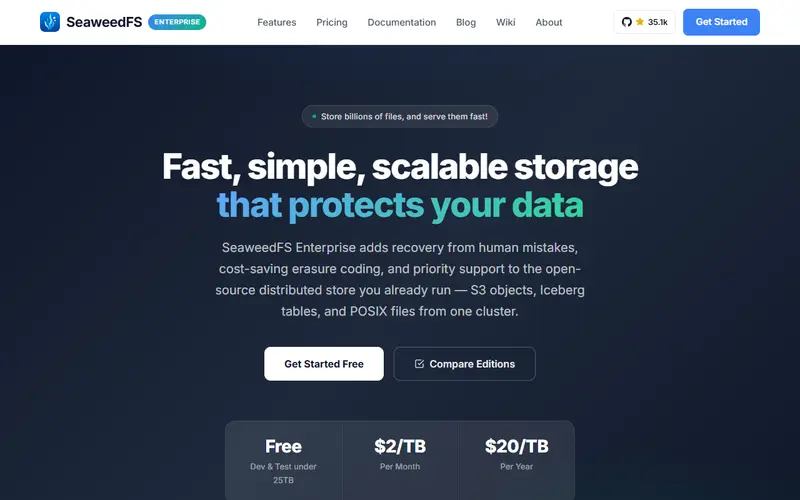
The core is Apache 2.0 licensed, which matters to teams wary of AGPL after MinIO's changes. SeaweedFS Enterprise is a licence key added to the same cluster, bringing point-in-time recovery to the second, sealed directories that shrink metadata, erasure coding tuned to your hardware (for example 20+4) and priority support. It is free for dev and test under 25 TB and otherwise $2 per TB per month.
SeaweedFS has more moving parts (master, volume, filer and gateway servers) than single-binary alternatives, so plan for some operational learning before running it in production.
Pricing and plans
| Plan | Price | What you get |
|---|---|---|
| Open source | $0 | Apache License 2.0 |
| Enterprise (dev and test) | $0 | Under 25 TB |
| Enterprise | $2/TB per month ($20/TB per year) | Point-in-time recovery, tunable erasure coding, priority support |
What it does
- Many protocols, one cluster
- S3, POSIX mount, WebDAV, HDFS-compatible access and Iceberg tables over the same data.
- Small-file performance
- Volume-based storage with O(1) disk access for billions of files.
- Erasure coding
- EC 10+4 by default; Enterprise allows custom ratios such as 20+4.
- Iceberg catalog
- Built-in REST catalog with background compaction and snapshot cleanup.
- Point-in-time recovery (Enterprise)
- Roll a folder, bucket or object back to any second in a retention window.
Strengths and limitations
Strengths
- Permissive Apache 2.0 licence
- Handles very large numbers of small files well
- S3, file-system and table access from one cluster
- Active development since 2014 with an optional commercial edition
Limitations
- Several components (master, volume, filer, S3 gateway) to deploy and operate
- Point-in-time recovery and custom erasure coding require the paid Enterprise licence
- Without AWS keys configured, the S3 gateway runs in an allow-all mode meant only for development
- Self-hosted only; no managed cloud service
Who it suits
Good for
- Self-hosted storage with billions of small files
- Teams wanting a permissive licence instead of AGPL
- Data lakes needing S3 and Iceberg on their own hardware
Look elsewhere if
- Teams wanting the simplest possible single-binary setup
- Anyone who wants a managed service
Alternatives to SeaweedFS
| Tool | From | Free option | Stages |
|---|---|---|---|
| Supabase Managed Postgres backend platform | $25/mo | Free tier | |
| OVHcloud Object Storage EU object storage | Usage-based | ||
| Uploadcare File upload, processing and CDN | $66/mo | Free tier | |
| Vultr Object Storage Tiered object storage | $6/mo | ||
| Backblaze B2 Cloud Storage Low-cost object storage | Usage-based | Free tier | |
| Storj Distributed object storage | Usage-based |
Questions
Is SeaweedFS S3 compatible?
Yes. It includes an S3-compatible gateway, plus POSIX, WebDAV and HDFS-compatible access.
What licence is SeaweedFS under?
The open-source edition is Apache License 2.0.
How much does SeaweedFS Enterprise cost?
$2 per TB per month or $20 per TB per year, and free for dev and test under 25 TB.
Is SeaweedFS a MinIO alternative?
Yes. It is a maintained, Apache-licensed self-hosted S3-compatible store, though with more components to run.
Sources read for this page