Overview
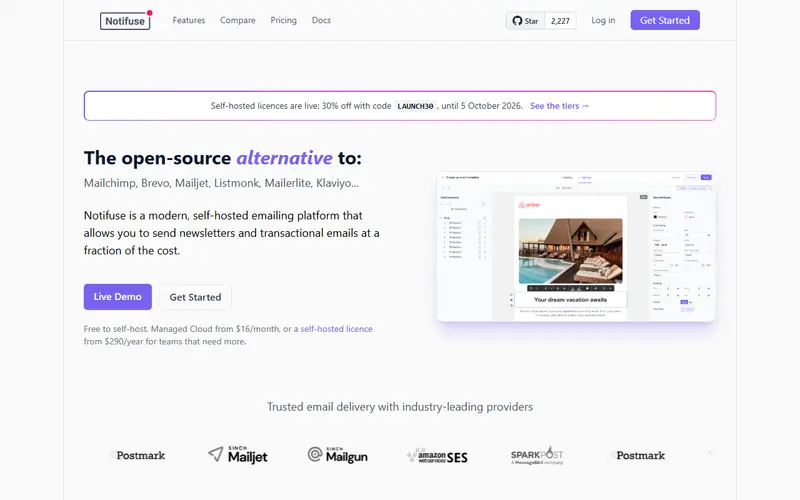
Notifuse is an open-source email platform that combines newsletters, marketing automation and a transactional API. You design emails with an MJML-based drag-and-drop builder or code editor and personalise them with Liquid, then send them through an email provider you connect.
Because delivery goes through your own ESP, Notifuse never charges per email. Self-hosting is free with every feature. Notifuse Cloud charges by active contacts, meaning contacts with any event in the last 30 days; dormant contacts do not count toward the limit.
Cloud plans run from $19 a month for 2,500 active contacts to $319 for 50,000, with every feature on every plan and differences only in scale, workspaces, team size and data retention. The vendor gives the example of SES costing about $5 for 50,000 emails on top of a plan.
The trade-off is that you must set up and manage your own sending provider and its reputation, and it is a younger project than the long-established suites.
Pricing and plans
| Plan | Price | What you get |
|---|---|---|
| Self-hosted | $0 | Open source, all features |
| Lite | $19/mo | 2,500 active contacts, 10,000 stored, 1 workspace, 3 members; $16/mo billed yearly |
| Starter | $49/mo | 10,000 active contacts, 50,000 stored, 5 workspaces; $39/mo yearly |
| Pro | $129/mo | 25,000 active contacts, 150,000 stored, 10 workspaces; $99/mo yearly |
| Business | $319/mo | 50,000 active contacts, 300,000 stored, 20 workspaces; $249/mo yearly |
| Enterprise | Custom | 50,000+ contacts, on-premise option, SLA |
What it does
- Bring your own ESP
- Send through Amazon SES, Postmark, SendGrid, Mailgun, Mailjet, SparkPost or SMTP; no per-email fees.
- Automation workflows
- Event-driven workflows with 10 node types on every plan.
- Transactional API
- REST API for transactional email with shared templates.
- Segmentation
- RFM, behavioural and nested segments, contact timelines and custom events.
- Web analytics and CMS
- Cookieless web analytics and a blog CMS with Liquid templating.
Strengths and limitations
Strengths
- Free to self-host with all features
- Cloud bills only recently active contacts
- No per-email charges from Notifuse
- Marketing and transactional email in one tool
Limitations
- You must configure your own ESP and manage deliverability
- No free cloud plan (14-day trial only)
- Younger project with a smaller community and fewer integrations
- Cloud plans cap stored contacts as well as active ones
Who it suits
Good for
- Developers who already use SES or Postmark
- SaaS teams wanting one tool for product and marketing email
- Teams that must self-host for data control
Look elsewhere if
- Non-technical marketers who do not want to manage an ESP
Alternatives to Notifuse
| Tool | From | Free option | Stages |
|---|---|---|---|
| Resend Email API for developers | $20/mo | Free tier | |
| Brevo Email marketing and transactional platform | $9/mo | Free tier | |
| Mailjet Email API, SMTP relay and campaign editor | $9/mo | Free tier | |
| Loops Lifecycle email for SaaS | $49/mo | Free tier | |
| GetResponse Email marketing and automation | $19/mo | Free tier | |
| Ghost Open-source publishing and newsletter platform | $18/mo | Free tier |
Questions
Is Notifuse free?
Self-hosting is free and open source. Notifuse Cloud starts at $19 a month.
Does Notifuse send emails itself?
No. You connect your own provider such as Amazon SES or Postmark, and pay that provider for sending.
What counts as an active contact in Notifuse?
A contact with at least one event, such as an email sent or list change, in the last 30 days.
Sources read for this page