Overview
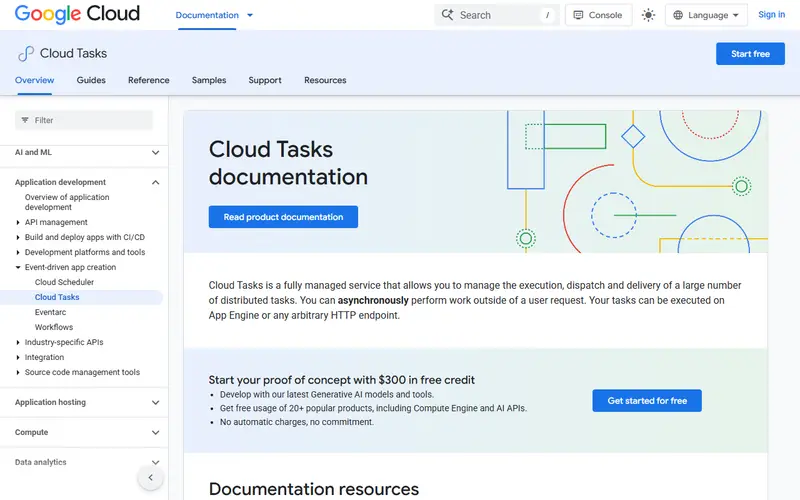
Cloud Tasks is a managed queue for discrete units of work. Your app creates a task naming a target (an HTTP URL, often Cloud Run or Cloud Functions, or an App Engine handler) and Cloud Tasks delivers it, retrying with backoff on failure and respecting the queue's rate and concurrency limits. Tasks can be scheduled for a future time and deduplicated by name.
Pricing is simple: the first 1 million billable operations a month are free, then $0.40 per million up to 5 billion. Both API calls and push delivery attempts count, including retries, and payloads are chunked at 32 KB.
Compared with Pub/Sub, Cloud Tasks gives explicit control over delivery rate and per-task scheduling; compared with job frameworks, it has no workflow steps or dashboard of results, so multi-step processes need Cloud Workflows or your own code.
Pricing and plans
Free tier · card required
First 1 million billable operations (API calls and push delivery attempts) each month
At the limit Bills overage Operations past the free million are billed at $0.40 per million to your billing account.
| Plan | Price | What you get |
|---|---|---|
| First 1M operations | Free | Per month |
| Up to 5 billion operations | $0.40 per million | Chunked at 32 KB |
| Over 5 billion | Custom | Contact sales |
What it does
- HTTP push delivery
- Tasks are delivered to any HTTP endpoint or App Engine, with optional OIDC or OAuth tokens for authenticated targets.
- Rate and concurrency control
- Each queue sets maximum dispatches per second and concurrent dispatches.
- Retries with backoff
- Configurable retry attempts, durations and backoff per queue.
- Scheduled tasks
- Set a schedule time to deliver a task in the future.
- Task deduplication
- Named tasks prevent the same task being created twice.
Strengths and limitations
Strengths
- 1 million free operations every month
- Push model works with serverless handlers on Cloud Run
- Per-queue rate limiting protects downstream services
- Regional queues, including EU regions
Limitations
- Every delivery attempt, including retries, is billed
- Payloads are billed per 32 KB chunk
- HTTP handlers must respond within 10 minutes by default, 30 minutes at most
- No workflow steps, result storage or run dashboard
- Tied to Google Cloud
- At-least-once delivery, so handlers must be idempotent
Who it suits
Good for
- Cloud Run or App Engine apps offloading slow work
- Rate-limited calls to third-party APIs
- Delayed one-off tasks
Look elsewhere if
- Multi-step durable workflows
- Apps not on Google Cloud that want an integrated job dashboard
Alternatives to Google Cloud Tasks
| Tool | From | Free option | Stages |
|---|---|---|---|
| Sidekiq Redis-based background job library for Ruby | $99/mo | ||
| Hangfire Background job library for .NET | $500/yr | ||
| Windmill Open-source job orchestrator, workflow engine and internal-tool platform | $10/mo | Free tier | |
| Oban SQL-backed job processing library for Elixir (and Python) | $135/mo | ||
| Celery Distributed task queue for Python | — | ||
| DBOS Postgres-backed durable workflow library | $99/mo |
Questions
Is Google Cloud Tasks free?
The first 1 million billable operations each month are free; after that it is $0.40 per million.
What counts as a Cloud Tasks operation?
Any API call or push delivery attempt, chunked at 32 KB of payload, so retries and large tasks count more than once.
Cloud Tasks or Pub/Sub?
Cloud Tasks gives per-task scheduling and explicit delivery rate control to one handler; Pub/Sub is for broadcasting events to many subscribers.
Can Cloud Tasks schedule a task for later?
Yes. Each task can have a schedule time for future delivery.
Sources read for this page