Overview
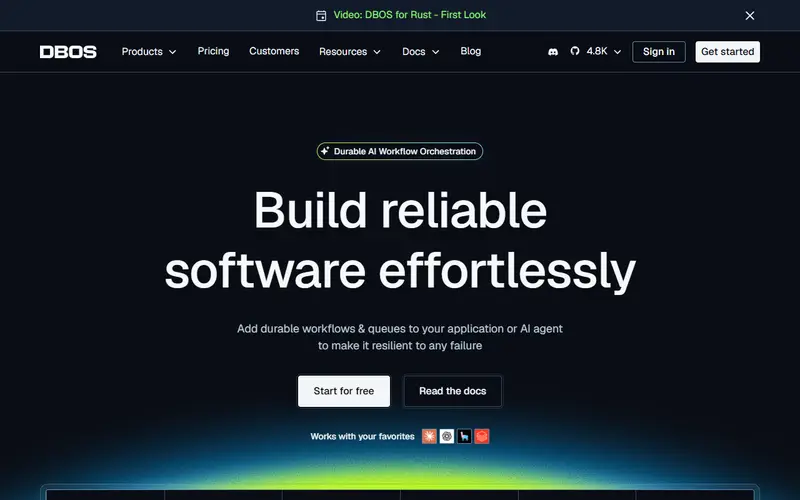
DBOS takes a library approach to durable execution. Instead of running an orchestrator service, you install DBOS Transact in your app, point it at Postgres, and decorate functions as workflows and steps. Each step's result is checkpointed in Postgres; if the process crashes, workflows resume from the last completed step when it restarts.
The same library provides durable queues (with per-queue or per-process concurrency, rate limits, deduplication, priorities and timeouts), scheduled workflows that run exactly once per interval, notifications and exactly-once event processing. Because workflows are rows in Postgres tables, you can query and manage them with SQL or scripts.
The library is MIT-licensed and free for any volume. The paid products are tooling and support: DBOS Conductor, a console for monitoring, recovering, versioning and forking workflows, is included in Pro ($99/month, 1 million checkpoints) and Teams ($499/month, 10 million), with Enterprise adding SSO and a self-hosted Conductor.
The trade-off is that your application's Postgres now carries workflow state and load, and each process must connect to it.
Pricing and plans
| Plan | Price | What you get |
|---|---|---|
| DBOS Transact | Free | MIT-licensed library; needs a Postgres database |
| DBOS Pro | $99/mo | Conductor console, 2 seats, 3 apps, 1M checkpoints/month then $50 per million |
| DBOS Teams | $499/mo | 10 seats, 10 apps, 10M checkpoints then $40 per million, RBAC, alerting, Slack support, SOC 2 and HIPAA |
| DBOS Enterprise | Custom | SSO/SAML, self-hosted Conductor, air-gapped environments |
What it does
- Durable workflows
- Annotate functions as workflows and steps; progress is checkpointed in Postgres and resumes after failure.
- Durable queues
- Postgres-backed queues with concurrency limits, rate limiting, deduplication, priorities and timeouts, no broker needed.
- Scheduled workflows
- Cron-style schedules that run a workflow exactly once per interval.
- Programmatic management
- Workflows are Postgres rows you can query, cancel, resume or fork.
- DBOS Conductor
- Paid console for monitoring, tracing, distributed recovery, versioning and forking of workflows.
Strengths and limitations
Strengths
- No separate orchestrator or broker; only Postgres
- MIT licence and free at any volume
- SDKs for Python, TypeScript, Go and Java
- Service is not cut off when paid limits are exceeded
Limitations
- Requires Postgres; workflow state and load go on that database
- Management console (Conductor) is paid from $99/month
- SSO/SAML only on Enterprise
- Only four languages supported
Who it suits
Good for
- Python or TypeScript apps on Postgres that need reliable background work
- Payments and data pipelines that must resume from checkpoints
- AI agents that call unreliable APIs
Look elsewhere if
- Apps without Postgres
- Teams that want a fully hosted queue with no database of their own
Alternatives to DBOS
| Tool | From | Free option | Stages |
|---|---|---|---|
| Sidekiq Redis-based background job library for Ruby | $99/mo | ||
| Oban SQL-backed job processing library for Elixir (and Python) | $135/mo | ||
| BullMQ Redis-based job queue library | $139/mo | ||
| Hangfire Background job library for .NET | $500/yr | ||
| Windmill Open-source job orchestrator, workflow engine and internal-tool platform | $10/mo | Free tier | |
| Celery Distributed task queue for Python | — |
Questions
Is DBOS free?
Yes. DBOS Transact is an MIT-licensed library you can use at any volume; paid plans add the Conductor console and support.
What does DBOS need to run?
Only a Postgres database, which stores workflow checkpoints and queues.
How much does DBOS Pro cost?
$99 a month for 2 seats, 3 apps and 1 million checkpoints, then $50 per million extra checkpoints.
Which languages does DBOS support?
Python, TypeScript, Go and Java.
Sources read for this page