Overview
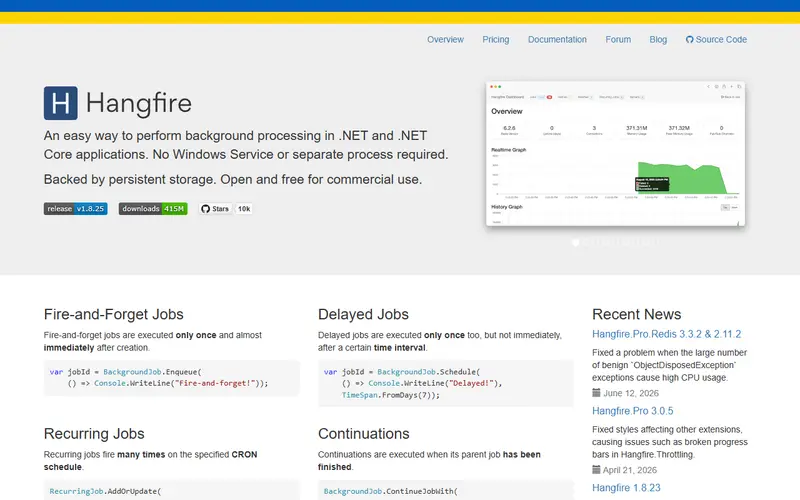
Hangfire is a background processing framework for .NET and .NET Core. Jobs are normal static or instance methods: BackgroundJob.Enqueue runs one almost immediately, Schedule delays it, RecurringJob.AddOrUpdate runs it on a cron schedule, and continuations run after a parent job finishes. Processing happens inside your application's process, so no separate Windows service is needed.
Jobs are persisted in storage (SQL Server officially, Redis with Pro, and many community storages), processed with at-least-once semantics, and retried automatically after exceptions or restarts. A built-in dashboard shows queues, job states, retries and recurring jobs.
Hangfire Core is LGPL 3.0 and free for commercial use. Subscriptions from $500 a year per organisation add Hangfire Pro (batches, batch continuations, Redis storage) and, on higher tiers, Hangfire Ace, source code and support. Licences are perpetual with a year of updates.
Pricing and plans
| Plan | Price | What you get |
|---|---|---|
| Open | Free | Hangfire Core under LGPL 3.0, commercial use allowed; SQL Server and in-memory storage; community support |
| Startup | $500/yr | Hangfire Pro (batches, Redis storage), private NuGet feed, perpetual licence |
| Business | $1,500/yr | Adds Hangfire Ace, source code access, email/helpdesk technical support |
| Enterprise | $4,500/yr | Royalty-free EULA, custom terms, priority support, invoice/PO |
What it does
- Job types
- Fire-and-forget, delayed, recurring (cron) and continuation jobs from ordinary .NET methods.
- Persistent storage
- SQL Server officially, Redis with Pro, plus community storages; survives app pool recycles.
- Automatic retries
- Unhandled exceptions or process termination lead to automatic retries with at-least-once processing.
- Dashboard
- Built-in web interface showing every job's state, queues and recurring jobs.
- Batches (Pro)
- Create groups of jobs atomically and run continuations when the batch completes.
- Job filters
- Extend processing with filters similar to ASP.NET MVC action filters.
Strengths and limitations
Strengths
- Free for commercial use with cron and a dashboard included
- Runs inside ASP.NET apps with no extra service
- Paid tiers are flat per organisation, not per developer or server
- Long-established in the .NET ecosystem
Limitations
- .NET only
- Free edition officially supports only SQL Server (and in-memory) storage
- Batches and Redis storage need a paid subscription
- Default SQL Server storage polls for jobs, adding latency unless extensions are used
Who it suits
Good for
- ASP.NET and .NET Core web apps
- Recurring maintenance jobs and email sending
- Teams already on SQL Server
Look elsewhere if
- Non-.NET stacks
- Complex multi-step durable workflows
Alternatives to Hangfire
| Tool | From | Free option | Stages |
|---|---|---|---|
| Sidekiq Redis-based background job library for Ruby | $99/mo | ||
| DBOS Postgres-backed durable workflow library | $99/mo | ||
| Oban SQL-backed job processing library for Elixir (and Python) | $135/mo | ||
| BullMQ Redis-based job queue library | $139/mo | ||
| Windmill Open-source job orchestrator, workflow engine and internal-tool platform | $10/mo | Free tier | |
| Amazon SQS Managed message queue | Usage-based | Free tier |
Questions
Is Hangfire free for commercial use?
Yes. Hangfire Core is LGPL 3.0 and free even in commercial and proprietary applications.
How much does Hangfire Pro cost?
Subscriptions are $500, $1,500 or $4,500 a year per organisation, regardless of developer count.
What storage does Hangfire use?
SQL Server officially, Redis with Hangfire Pro, and community-maintained storages for other databases.
Can Hangfire run cron jobs?
Yes. Recurring jobs run on cron schedules in the free edition.
Sources read for this page