Overview
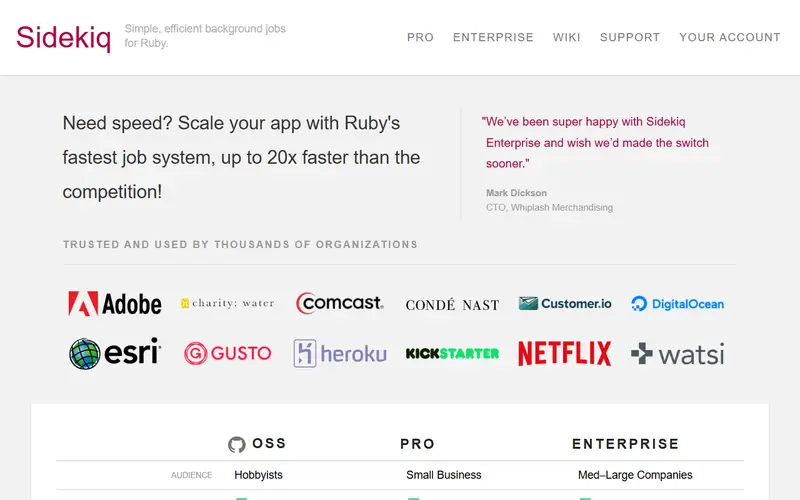
Sidekiq is a background job framework for Ruby, built by Mike Perham and sold by his company Contributed Systems. Jobs are pushed to Redis and processed by Sidekiq processes that each run many threads, which makes it efficient for I/O-heavy Rails workloads. It integrates with Rails Active Job or can be used directly.
The free edition, licensed LGPLv3, includes scheduled jobs, automatic retries with backoff, a web dashboard and middleware. Losing a job when a process crashes mid-job is possible in the free edition; Sidekiq Pro ($99/month or $995/year, unlimited usage) adds reliable fetch so jobs survive crashes, a client that buffers jobs during Redis outages, batches with callbacks, queue pausing and expiring jobs.
Sidekiq Enterprise, from $269 a month per 100 threads, adds rate limiting, cron jobs, unique jobs, rolling restarts, multi-process management, historical metrics, encryption and Web UI authorisation. Buying either paid edition replaces the LGPL with a commercial licence.
Pricing and plans
| Plan | Price | What you get |
|---|---|---|
| Sidekiq OSS | Free | LGPLv3; scheduled jobs, retries, Web UI, middleware |
| Sidekiq Pro | $99/mo or $995/yr | Unlimited usage; batches, reliable fetch, expiring jobs, worker metrics, email support |
| Sidekiq Enterprise | From $269/mo per 100 threads | Rate limiting, cron, unique jobs, rolling restarts, encryption, Web UI authorisation |
What it does
- Multithreaded workers
- Each process runs many threads, so fewer processes handle more concurrent I/O-bound jobs.
- Retries and scheduled jobs
- Failed jobs retry automatically with backoff; jobs can be scheduled for a later time.
- Web UI
- Dashboard for queues, retries, scheduled and dead jobs; multi-cluster view in Pro.
- Batches (Pro)
- Group jobs, track progress and run callbacks when all finish.
- Cron and rate limiting (Enterprise)
- Periodic jobs, unique jobs and rate limiters for external APIs.
- Reliable fetch (Pro)
- Jobs are not lost if a process crashes or is killed while working.
Strengths and limitations
Strengths
- Standard choice for Rails with a large ecosystem
- Efficient multithreaded processing
- Flat $99/month Pro price with unlimited usage
- Actively maintained by its original author
Limitations
- Ruby only
- Free edition can lose in-progress jobs if a process crashes
- Cron, unique jobs and rate limiting require Enterprise
- Needs a Redis server
Who it suits
Good for
- Rails applications of any size
- High-volume email, webhook and import jobs
- Companies wanting commercial support for their job system
Look elsewhere if
- Non-Ruby stacks
- Teams that want cron and uniqueness free without adding other gems
Alternatives to Sidekiq
| Tool | From | Free option | Stages |
|---|---|---|---|
| DBOS Postgres-backed durable workflow library | $99/mo | ||
| Oban SQL-backed job processing library for Elixir (and Python) | $135/mo | ||
| BullMQ Redis-based job queue library | $139/mo | ||
| Hangfire Background job library for .NET | $500/yr | ||
| Windmill Open-source job orchestrator, workflow engine and internal-tool platform | $10/mo | Free tier | |
| Amazon SQS Managed message queue | Usage-based | Free tier |
Questions
Is Sidekiq free?
Yes, the open-source edition is free under LGPLv3; Pro and Enterprise are paid.
How much does Sidekiq Pro cost?
$99 a month or $995 a year with unlimited usage.
Does free Sidekiq support cron jobs?
Not natively; cron jobs are a Sidekiq Enterprise feature, though community gems exist.
Does Sidekiq need Redis?
Yes. Sidekiq stores its queues in Redis.
Sources read for this page