Overview
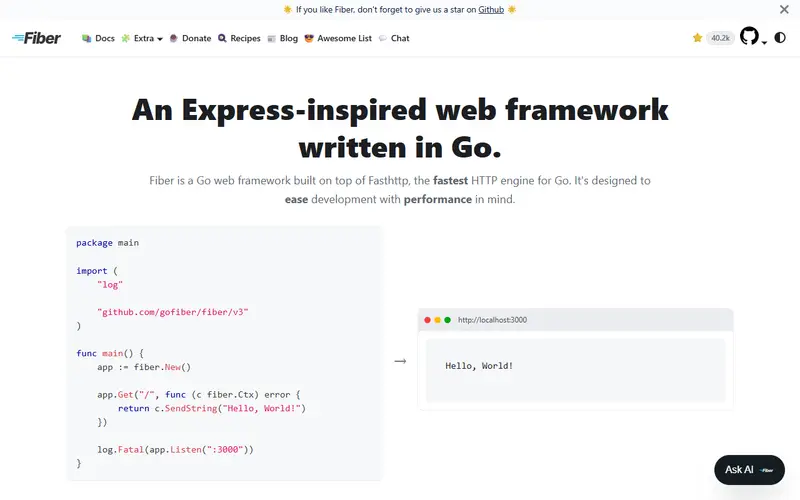
Fiber is a web framework for Go inspired by Express. It is built on Fasthttp, described by the project as the fastest HTTP engine for Go, rather than on the standard net/http server, and it is designed around zero memory allocation. Its API will feel familiar to Node developers: app.Get, app.Use and middleware that calls Next.
The project describes itself as batteries-included: built-in middleware (static files with caching and compression, proxy and load balancing, rate limiting and more), officially maintained template engines and storage drivers, WebSocket and Server-Sent Events support. It covers JSON APIs, SPAs, server-rendered apps, gateways and microservices.
The current docs cover Fiber v3, which requires Go 1.25 or newer; a migration guide and CLI tool help move from v2. The project began in January 2020 and is maintained by the gofiber organisation.
The zero-allocation design has a catch the README spells out: values returned from fiber.Ctx are reused across requests, so you must not keep references to them after the handler returns.
Pricing and plans
What it does
- Express-style API
- app.Get, app.Use and Next-based middleware.
- Fasthttp engine
- Built on Fasthttp for throughput and low memory.
- Built-in middleware
- Static files, proxy, rate limiter and more.
- Template engines and storage
- Officially maintained template engines and storage drivers.
- Real-time
- WebSocket and Server-Sent Events support.
- v2 to v3 migration tool
- Guide and CLI tool for upgrading.
Strengths and limitations
Strengths
- Easy switch for Express developers
- High throughput and low memory use
- Many official middleware and integrations
- Active maintenance with a current major version
Limitations
- Context values are reused across requests; keeping references after the handler returns causes bugs
- Built on Fasthttp instead of net/http, so standard-library handlers and middleware need Fiber's adaptor middleware to run
- v3 is a breaking upgrade from v2 and needs Go 1.25+
- No ORM or project structure built in
Who it suits
Good for
- Node developers moving to Go
- High-throughput APIs and gateways
- Small services that want many official middleware
Look elsewhere if
- Teams that want to stay on the standard net/http ecosystem
- Full-stack apps needing ORM and admin
Pricing history
-
Fiber v3.0.0 released
Fiber v3 was published on 2 February 2026 with a new binding API, an interface-based Ctx, a rewritten client and many breaking changes; a CLI migration tool helps move from v2. Source ↗
Alternatives to Fiber
| Tool | From | Free option | Stages |
|---|---|---|---|
| Phoenix Elixir web framework | — | ||
| Django Batteries-included Python web framework | — | ||
| Encore Backend framework with infrastructure from code | $49/mo | Free tier | |
| Fastify High-performance Node.js web framework | — | ||
| Express Minimal Node.js web framework | — | ||
| Litestar Python ASGI API framework | — |
Questions
Is Fiber like Express?
Yes. Its API is modelled on Express, but it is written in Go on Fasthttp.
Does Fiber use net/http?
No. It is built on Fasthttp.
Which Go version does Fiber v3 need?
Go 1.25 or higher.
Is Fiber free?
Yes, it is MIT licensed.
Sources read for this page