Overview
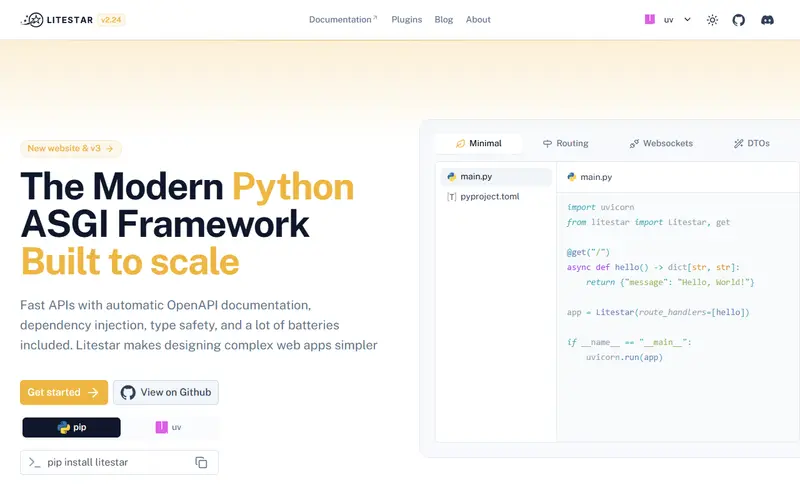
Litestar is an ASGI framework focused on building APIs. Like FastAPI it uses type hints for validation and generates OpenAPI documentation (with Swagger UI, ReDoc, Scalar, RapiDoc and Elements renderers), but it is more opinionated and includes more structure: class-based controllers, routers, dependency injection, layered middleware, route guards, lifecycle hooks and a DTO system that controls which fields go in and out.
It works with Pydantic, dataclasses, attrs, TypedDict and msgspec models, using msgspec internally for fast parsing. Configuration is hierarchical, so settings can be overridden at application, controller or route level. Official plugins include Advanced Alchemy for SQLAlchemy repositories and services, a Vite integration, queues and others.
The project started in December 2021 as Starlite, a Starlette-based solution, and was later renamed Litestar; it is now its own ASGI framework. It is maintained by a group of core developers under the litestar-org GitHub organisation rather than a single author, and funded by sponsors.
Its community and third-party ecosystem are much smaller than FastAPI's, so expect fewer tutorials and integrations.
Pricing and plans
What it does
- Class-based controllers
- Group routes in controllers and routers with layered configuration.
- DTOs
- Data transfer objects control which fields are accepted and returned.
- Multiple model libraries
- Pydantic, msgspec, dataclasses, attrs and TypedDict supported.
- SQLAlchemy integration
- Advanced Alchemy plugin adds repositories, services and session handling.
- OpenAPI renderers
- Swagger UI, ReDoc, Scalar, RapiDoc and Elements.
- Guards and hooks
- Route guards for authorisation and request lifecycle hooks.
Strengths and limitations
Strengths
- More built-in structure than FastAPI for larger APIs
- Maintained by several core developers
- Works with many data-model libraries, including fast msgspec
- First-class SQLAlchemy tooling
Limitations
- Smaller community, fewer tutorials and fewer third-party integrations than FastAPI or Django
- Opinionated conventions (controllers, DTOs, layers) take time to learn
- API-focused; no admin interface
- Renamed from Starlite, so older guides and packages use the previous name
Who it suits
Good for
- Larger typed Python APIs
- Teams wanting DI, DTOs and SQLAlchemy integration built in
- Developers who want a FastAPI alternative with multiple maintainers
Look elsewhere if
- Beginners who benefit from FastAPI's larger tutorial base
- Full web apps that need an admin and templates (see Django)
Alternatives to Litestar
| Tool | From | Free option | Stages |
|---|---|---|---|
| Flask Python micro web framework | — | ||
| Fastify High-performance Node.js web framework | — | ||
| Hono Web-standards TypeScript web framework | — | ||
| Fiber Express-inspired Go web framework | — | ||
| ASP.NET Core .NET web framework | — | ||
| Ruby on Rails Full-stack Ruby web framework | — |
Questions
Is Litestar the same as Starlite?
Yes. The project started as Starlite and was renamed Litestar.
Litestar or FastAPI?
Litestar has more built-in structure (controllers, DTOs, layered config) and several maintainers; FastAPI has the far larger ecosystem.
Does Litestar support Pydantic?
Yes, along with msgspec, dataclasses, attrs and TypedDict.
Is Litestar free?
Yes, it is MIT licensed.
Sources read for this page