Skip to content
whichdevtool?
Categories ▾

Frameworks and UI

Frontend and full-stack frameworks Backend frameworks UI component libraries

Hosting

VPS and cloud servers App hosting and PaaS

Data

Managed databases File and object storage ORMs and database toolkits

AI

AI model APIs

Email

Transactional email APIs Email marketing and newsletters

Payments

Payments and billing

Domains and edge

Domain registrars CDN, DNS and edge security

Operations and identity

Monitoring, uptime and error tracking Auth and identity Background jobs, queues and workflows
Stacks Directory
Ctrl K

Search directory
Menu
StacksDirectory Pricing changes Glossary
VPS and cloud servers App hosting and PaaS Managed databases Transactional email APIs Email marketing and newsletters Domain registrars CDN, DNS and edge security Monitoring, uptime and error tracking Auth and identity Frontend and full-stack frameworks Backend frameworks UI component libraries AI model APIs File and object storage Payments and billing Background jobs, queues and workflows ORMs and database toolkits
  1. Home
  2. Backend frameworks
  3. Phoenix

Elixir web framework · by Phoenix core team (Chris McCord)

Phoenix

An Elixir web framework on the Erlang VM with LiveView for server-rendered interactive pages, built-in PubSub, Channels and Presence for real-time features.

Visit phoenixframework.org ↗ Alternatives Open source Open source Self-hostable
phoenixframework.org
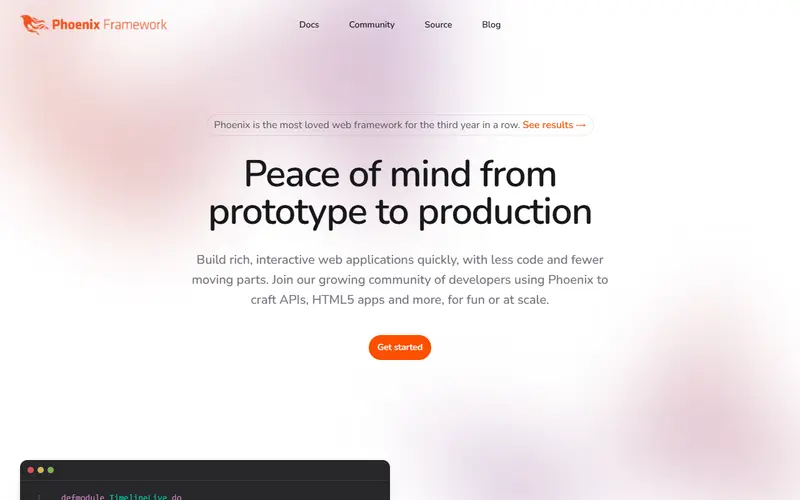
Phoenix homepage
§1

Overview

Phoenix is a web framework for Elixir that runs on the Erlang VM. It is known for LiveView, which renders interactive pages on the server and pushes updates over a WebSocket, so features such as live feeds, forms with validation and dashboards can be built with little custom JavaScript. HEEx templates and function components give compiler-checked attributes and slots.

Real-time features are built in: PubSub and Channels broadcast events across one or many nodes, and Presence tracks who is connected without an extra dependency. The site says Phoenix can handle millions of WebSocket connections, relying on the Erlang VM's concurrency.

Out of the box you get mix phx.gen.auth for authentication, Ecto for databases (Postgres, MySQL, SQLite and SQL Server adapters built in), JSON API support, built-in metrics with a live dashboard, and an optional generated Dockerfile. For GraphQL the site points to the Absinthe library.

Phoenix was created by Chris McCord in 2014, is MIT licensed, and counts Elixir's creator José Valim among its top contributors.

§2

Pricing and plans

Free and open source under the MIT licence. No paid edition; the repository points to DockYard for paid consulting.

Source: www.phoenixframework.org/ · prices as published, excluding tax.

§3

What it does

LiveView
Server-rendered interactive UI over WebSockets with streams and components.
PubSub and Channels
Real-time messaging across one or dozens of nodes.
Presence
Track connected users across a cluster with no external dependency.
Auth generator
mix phx.gen.auth generates a full authentication system.
Ecto
Database layer with Postgres, MySQL, SQLite and SQL Server adapters.
Live dashboard
Built-in instrumentation and metrics dashboard.
§4

Strengths and limitations

Strengths

  • Real-time features without extra infrastructure
  • Interactive UIs with little JavaScript via LiveView
  • Erlang VM concurrency and fault tolerance
  • Compiler-checked components and built-in formatting

Limitations

  • Requires learning Elixir and the Erlang VM, a smaller talent pool than JavaScript, Python or PHP
  • LiveView keeps a persistent WebSocket connection per user, which shapes how you host and scale
  • GraphQL needs a separate library (Absinthe)
  • Fewer third-party libraries and hosting guides than mainstream stacks
§5

Who it suits

Good for

  • Real-time apps: chat, dashboards, collaboration
  • Teams wanting interactive UIs without a heavy SPA
  • Systems that need high connection counts

Look elsewhere if

  • Teams that must hire from the largest language pools
  • Static sites or tiny functions
§6

Pricing history

  • 5 Aug 2025

    Phoenix 1.8 released

    Released 5 August 2025: scopes for secure data access, magic-link login in phx.gen.auth, dark mode support and an AGENTS.md in new apps. It requires Erlang/OTP 25+ and is backwards compatible with some deprecations. Source ↗

§7

Alternatives to Phoenix

Tool From Free option Stages
Laravel Batteries-included PHP framework
$5/mo Open source
Ec
Echo Go HTTP web framework
— Open source
Django Batteries-included Python web framework
— Open source
Ruby on Rails Full-stack Ruby web framework
— Open source
Li
Litestar Python ASGI API framework
— Open source
Flask Python micro web framework
— Open source

All backend frameworks →

§8

Questions

What is Phoenix LiveView?

A Phoenix library that renders interactive pages on the server and updates them over WebSockets.

Is Phoenix free?

Yes, it is MIT licensed.

Which databases does Phoenix support?

Through Ecto: Postgres, MySQL, SQLite and SQL Server are built in.

Does Phoenix have authentication?

Yes. mix phx.gen.auth generates a complete authentication system.

Sources read for this page

  • https://www.phoenixframework.org/
  • https://github.com/phoenixframework/phoenix
Spec sheet
From
Open source
Free tier
Free to self-host
Stages
HobbyIndieStartupScale-upEnterprise Suits hobby, indie, startup, scale-up
Language
Elixir
Style
Batteries-included, real-time
Runs on
Erlang VM (BEAM)
Maintained by
Core team led by Chris McCord, sponsor DockYard
Open source
Yes
Self-host
Yes
EU data
Not stated
Category
Backend
Visit phoenixframework.org ↗

To report an out-of-date price or limit, use the correction form.

whichdevtool?

Developer and cloud tools compared on price, free tier and limits, each with its source. For side projects, solo developers and small teams.

Categories

  • VPS and cloud servers
  • App hosting and PaaS
  • Managed databases
  • Transactional email APIs
  • Email marketing and newsletters
  • Domain registrars
  • CDN, DNS and edge security
  • Monitoring, uptime and error tracking
  • Auth and identity
  • Frontend and full-stack frameworks
  • Backend frameworks
  • UI component libraries
  • AI model APIs
  • File and object storage
  • Payments and billing
  • Background jobs, queues and workflows
  • ORMs and database toolkits

Research

  • Directory
  • Stacks by project
  • Developer news
  • Pricing changes
  • Glossary

Site

  • About and methods
  • How we make money
  • Suggest a tool or fix
  • Privacy
© 2026 whichdevtool.com Prices change. Each tool page links to its source. We may earn a commission when you sign up through links on this site. How we make money