Overview
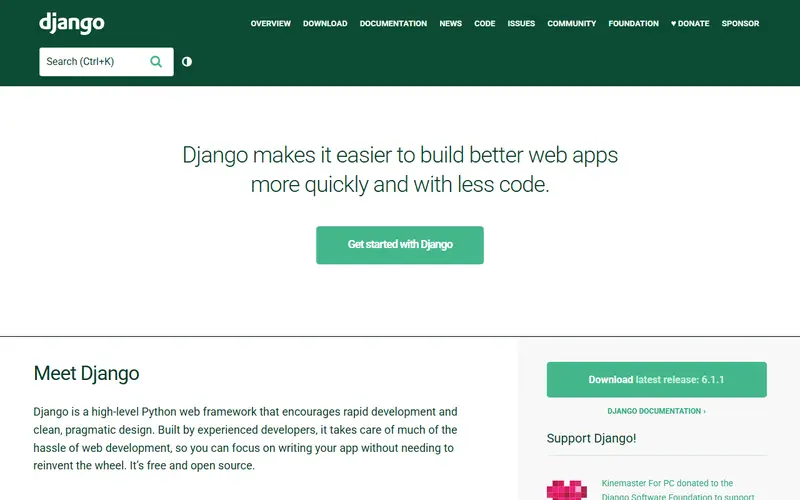
Django is a high-level Python web framework that grew out of a newspaper web team in Lawrence, Kansas, and was open-sourced in 2005. It is now run by an international team of volunteers under the Django Software Foundation and distributed under the BSD licence.
It is batteries-included: an ORM with migrations, an automatic admin interface, user authentication and permissions, forms, a template language, caching, internationalisation and built-in protections against common security mistakes. The project cites Instagram, Pinterest, Disqus and Mozilla among long-time users, and describes a shared-nothing architecture that scales by adding servers at any layer.
Releases are predictable. Feature releases have used A.B version numbers roughly every eight months with designated long-term support versions; the download page says 6.2 LTS (April 2027) is the last under that policy, and from Django 2028 every feature release will ship each January with the same three-year support period.
For JSON APIs most teams add a third-party package such as Django REST Framework or Django Ninja. There is no official paid tier or hosting product.
Pricing and plans
What it does
- ORM and migrations
- Model classes map to database tables, with automatic schema migrations.
- Admin interface
- A generated admin site for managing data, configurable per model.
- Auth and permissions
- Users, groups, permissions and sessions built in.
- Security defaults
- The project says Django helps developers avoid many common security mistakes by default.
- Forms and templates
- Form handling and validation plus the Django template language.
- Long-term support
- LTS releases with about three years of security fixes.
Strengths and limitations
Strengths
- Admin, ORM, auth and migrations out of the box
- Long track record and predictable security support windows
- Very large ecosystem of reusable apps
- Foundation-run rather than company-owned
Limitations
- Monolithic: you take its ORM, templates and project structure, which can feel heavy for small APIs
- JSON APIs usually need a third-party package such as Django REST Framework or Django Ninja
- Non-LTS feature releases get only about eight months of mainstream support, so apps must upgrade regularly or stay on LTS
- The versioning and support policy changes from 2028 (year-based versions every January)
Who it suits
Good for
- Content sites, marketplaces and SaaS back ends
- Internal tools that benefit from the admin
- Teams that want security defaults and long support
Look elsewhere if
- Tiny async microservices (see FastAPI or Litestar)
- Teams that dislike framework conventions
Pricing history
-
Django 6.0 released
Released 3 December 2025. With it, Django 5.2 LTS left mainstream support and receives only security and data-loss fixes until April 2028. Source ↗
Alternatives to Django
| Tool | From | Free option | Stages |
|---|---|---|---|
| Ruby on Rails Full-stack Ruby web framework | — | ||
| Fastify High-performance Node.js web framework | — | ||
| ASP.NET Core .NET web framework | — | ||
| Gin Go HTTP web framework | — | ||
| Encore Backend framework with infrastructure from code | $49/mo | Free tier | |
| Laravel Batteries-included PHP framework | $5/mo |
Questions
Is Django free?
Yes. It is BSD licensed and has no paid edition.
Is Django good for APIs?
Yes, usually with Django REST Framework or Django Ninja on top of its ORM and auth.
Which Django version should I use?
The latest release or the current LTS; the download page lists support end dates for each series.
Does Django scale?
The project says yes, citing a shared-nothing architecture and sites such as Instagram and Pinterest.
Sources read for this page