Overview
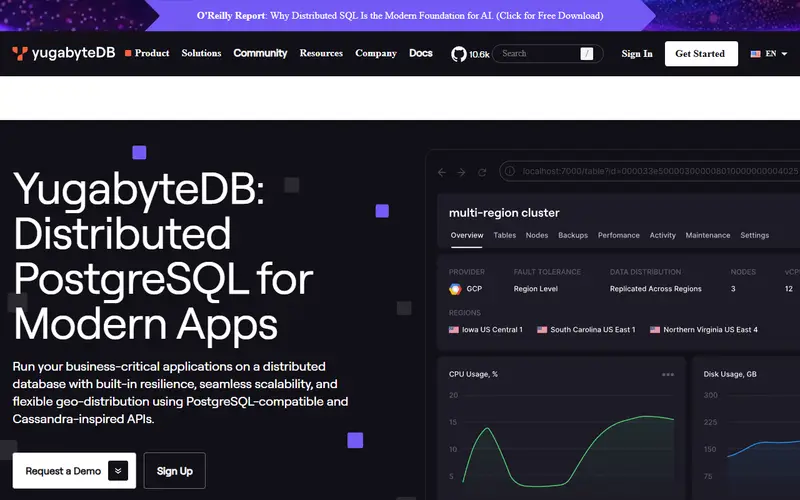
YugabyteDB is an open-source distributed SQL database. It reuses the upper half of PostgreSQL, so the YSQL API accepts Postgres drivers, ORMs and many extensions, while the storage layer shards and replicates data automatically across nodes with the Raft protocol. It also offers a Cassandra-style API. YugabyteDB Aeon is Yugabyte's managed service on AWS, Azure and Google Cloud, with a bring-your-own-cloud option.
Pricing is per provisioned vCPU per month. Standard starts at $125/vCPU for single-region clusters that survive node or zone outages. Professional starts at $167/vCPU and adds multi-region clusters, read replicas and row-level geo-partitioning for data residency, with enterprise security and point-in-time recovery sold as $25/vCPU add-ons. Storage, backup storage and data transfer are billed separately. Yugabyte recommends at least three nodes with 4 to 8 vCPUs each for production.
The free Sandbox is a single-node cluster for learning, with up to 2 vCPUs, 4 GB RAM and 10 GB storage, 15 connections and roughly 500 tables. It pauses after 10 days without activity and is deleted after 15. Because it is single-node it cannot show YugabyteDB's resilience or performance; a free trial of bigger clusters is available on request.
Pricing and plans
Free tier
Sandbox: one single-node cluster with up to 2 vCPUs, 4 GB RAM and 10 GB storage on AWS or GCP, 15 connections, about 500 tables or 12.5M rows; paused after 10 days idle, deleted after 15.
At the limit Not stated The vendor does not say what happens at the limit, or we have not found it yet.
Paused if unused| Plan | Price | What you get |
|---|---|---|
| Sandbox | $0 | Single node, up to 2 vCPU, 4 GB RAM, 10 GB; not for production; pauses when idle |
| Standard | From $125/vCPU/mo | Zone-level resilience, VPC peering and Private Link, 24x7 support |
| Professional | From $167/vCPU/mo | Multi-region clusters, read replicas, geo-partitioning; SSO/CMEK and PITR/DR add-ons at $25/vCPU/mo each |
| Enterprise | Custom | Enterprise security, PITR and DR included, bring-your-own-cloud option |
What it does
- PostgreSQL-compatible API
- YSQL reuses PostgreSQL's query layer, so Postgres drivers, ORMs and extensions like pg_stat_statements work.
- Automatic sharding and replication
- Data is split and replicated across nodes with Raft; a cluster tolerates node, zone or region failures depending on topology.
- Geo-partitioning
- Pin rows to specific regions for data residency, or replicate across three regions synchronously.
- Built-in connection pooling
- A connection manager removes the need for an external pooler; clusters support 15 connections per vCPU.
- Vector search
- Vector indexing distributed across the cluster for RAG and AI workloads using SQL.
- Migration tooling
- YugabyteDB Voyager migrates schema and data from PostgreSQL and Oracle, including live migration.
Strengths and limitations
Strengths
- Postgres compatibility with horizontal scale and automatic failover
- Multi-region and geo-partitioned topologies for global apps and data residency
- Runs on AWS, Azure and GCP at the same price
- Fully open-source database that can be self-hosted
- 24x7 support on every paid tier
Limitations
- Per-vCPU pricing plus a recommended three-node minimum makes production clusters expensive for small apps
- Sandbox is single-node, limited to 15 connections, and deleted after 15 days of inactivity
- Point-in-time recovery and SSO are add-ons below the Enterprise tier
- Storage, backups and data transfer are billed on top
- Azure does not support Sandbox clusters or VPC peering
Who it suits
Good for
- Business-critical apps that must survive zone or region outages
- Global apps needing data residency by region
- Teams that need more than a single PostgreSQL server
Look elsewhere if
- Small apps where a single managed Postgres instance is enough
- Hobby projects needing an always-on free database
Alternatives to YugabyteDB Aeon
| Tool | From | Free option | Stages |
|---|---|---|---|
| Tiger Cloud Managed PostgreSQL with TimescaleDB | $30/mo | Free tier | |
| Convex Reactive backend and document database | $25/mo | Free tier | |
| Supabase Managed Postgres backend platform | $25/mo | Free tier | |
| Crunchy Bridge Managed PostgreSQL on AWS, Azure and GCP | $9/mo | ||
| MongoDB Atlas Managed document database | $8/mo | Free tier | |
| Render Managed PaaS | $7/mo | Free tier |
Questions
Is YugabyteDB Aeon free?
There is a free Sandbox cluster (single node, up to 2 vCPU, 4 GB RAM, 10 GB) for learning. It pauses after 10 days idle and is deleted after 15.
How much does YugabyteDB Aeon cost?
Standard starts at $125 per vCPU per month and Professional at $167, plus storage at $0.10/GB-month and data transfer.
Is YugabyteDB compatible with PostgreSQL?
Its YSQL API reuses PostgreSQL's query layer, so most Postgres drivers, ORMs and tools work.
Is YugabyteDB open source?
Yes. The database is open source and free to self-host; Aeon is the paid managed service.
Which clouds does YugabyteDB Aeon support?
AWS, Azure and Google Cloud, with the same pricing on each.
Sources read for this page