Overview
Temporal is a durable execution engine: you write workflows and activities in a normal programming language, and the Temporal service records every step in an event history. If a worker crashes or is redeployed, the workflow replays its history and continues from the same point. It provides retries with backoff, timers that sleep for months, cron schedules with backfill, signals and updates to running workflows, child workflows and task-queue priority.
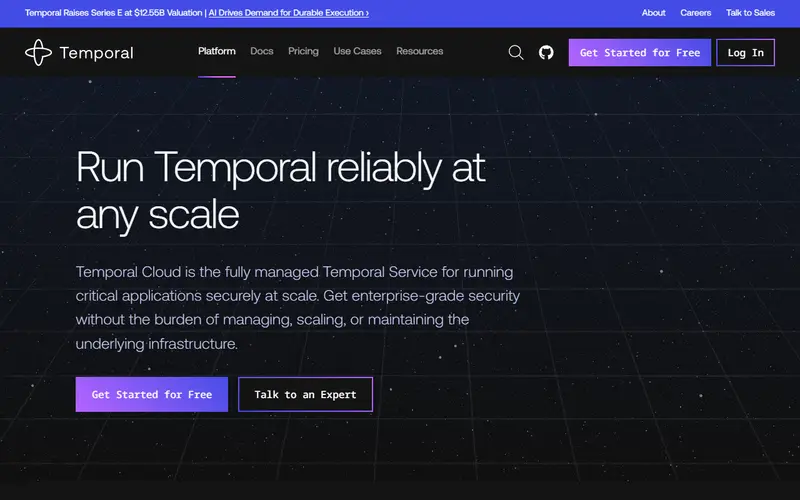
Temporal Cloud runs the Temporal service for you in AWS and Google Cloud regions, including Frankfurt, Ireland and London; you still run your own workers. Billing is per action (workflow starts, activities, timers, signals, queries, schedules) from $50 per million, falling to $25 per million with volume, plus workflow-history storage by the gigabyte-hour. The current pricing page lists no base monthly fee and a $150 credit for 90 days, but there is no permanent free tier.
The Business plan ($500/month minimum or 10% of usage) buys faster support; Enterprise and Mission Critical are annual contracts. SAML SSO is included on every plan.
The open-source Temporal server is MIT-licensed and widely self-hosted, but it needs a database (such as PostgreSQL, MySQL or Cassandra) and several services to operate, which is the main reason teams pay for Cloud.
Pricing and plans
| Plan | Price | What you get |
|---|---|---|
| Pay-As-You-Go | From $50 per million actions | No base fee; active storage $0.042/GBh, retained $0.00105/GBh; developer support at 10% of usage; SAML SSO |
| Volume discounts | Down to $25 per million actions | Self-serve tiered discounts; larger discounts with a commitment |
| Business | From $500/mo | Greater of $500/mo or 10% of usage; 2.5M actions and 100 GB retained storage included; 2-hour P0 response in business hours |
| Enterprise / Mission Critical | Custom | Annual; 10M actions included, 30-minute (15 with Mission Critical) 24/7 P0 response, SCIM |
| Self-hosted Temporal | Free | MIT-licensed server you operate with your own database |
What it does
- Durable workflows
- Workflow state survives crashes and deploys through event-history replay, with no checkpoint code.
- Failure handling
- Automatic retries with backoff, four timeout types, heartbeating and saga compensation.
- Schedules and timers
- Durable timers that sleep for months and cron schedules with backfill.
- Signals, queries and updates
- Read or change running workflows from outside while they execute.
- Worker versioning
- Pin workflows to a code version and replay-test against real histories before deploying.
- Multi-region replication
- Namespaces can replicate across regions and clouds for 99.99% availability.
Strengths and limitations
Strengths
- SDKs in eight languages, the widest in this category
- Proven at large scale; the server is MIT-licensed and portable
- No base fee on pay-as-you-go and SAML SSO on every plan
- EU regions (Frankfurt, Ireland, London) and multi-region HA
- SOC 2 and HIPAA
Limitations
- No permanent free tier; only $150 of credit for 90 days
- Every activity, timer and signal is a billed action, so step-heavy workflows cost more
- You still run and scale your own worker processes
- Workflow code must be deterministic, which is a learning curve
- Faster support starts at $500/month
Who it suits
Good for
- Payments, order processing and other business processes that must not lose state
- Long-running AI agents and human-in-the-loop flows
- Polyglot teams needing one orchestration platform across languages
Look elsewhere if
- Hobby projects wanting a permanent free cloud tier
- Simple fire-and-forget jobs where a Redis or Postgres queue is enough
Pricing history
-
Temporal Cloud drops the base plan fee for new sign-ups
Around mid-September 2026 Temporal's pricing page switched its entry offer to pay-as-you-go with no base monthly fee, $50 per million actions and $150 of credit for 90 days, replacing the $100/month Essentials minimum; Business stays from $500/month. Date is approximate, from a Temporal staff post on 15 September 2026 and third-party coverage. Source ↗
-
Temporal Cloud moves customers to Essentials and Business plans
Announced 6 November 2024 and applied to pay-as-you-go customers in February 2025: plans became the greater of $100/mo or 5% of usage (Essentials) or $500/mo or 10% (Business), replacing the $200 Basic support tier; volume discounts start at 5M actions. Source ↗
Alternatives to Temporal Cloud
| Tool | From | Free option | Stages |
|---|---|---|---|
| BullMQ Redis-based job queue library | $139/mo | ||
| Hangfire Background job library for .NET | $500/yr | ||
| Sidekiq Redis-based background job library for Ruby | $99/mo | ||
| Amazon SQS Managed message queue | Usage-based | Free tier | |
| Celery Distributed task queue for Python | — | ||
| DBOS Postgres-backed durable workflow library | $99/mo |
Questions
Is Temporal Cloud free?
No. New accounts get $150 of credit for 90 days; after that usage is billed from $50 per million actions. The Temporal server itself is free and open source to self-host.
What is a Temporal action?
A billable operation such as starting a workflow, running an activity, a timer, a signal, a query or a schedule trigger.
Is there a minimum monthly fee for Temporal Cloud?
The current pricing page lists pay-as-you-go with no base monthly fee; the Business plan has a $500/month minimum.
Can I self-host Temporal?
Yes. The Temporal server is MIT-licensed, but you operate its services and a database yourself.
Does Temporal Cloud have EU regions?
Yes, including AWS Frankfurt, Ireland and London.
Sources read for this page