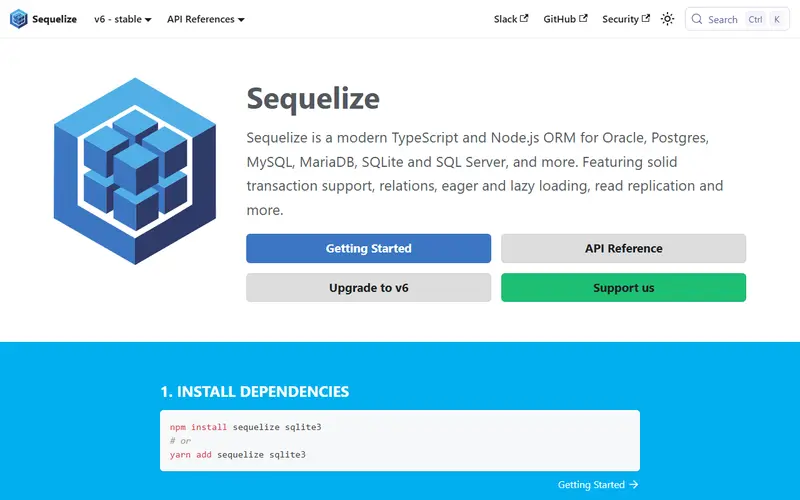
Overview
Sequelize is one of the oldest Node.js ORMs, created in 2010. You define models with sequelize.define or classes, declare associations such as hasMany and belongsTo, and get generated helper methods like getWishes() on instances. It supports transactions, eager and lazy loading, read replicas, scopes, hooks and paranoid tables that soft-delete rows.
Version 6, released in June 2020, is the stable line and still receives patch releases (6.37.8 on 7 March 2026). Version 7, published as @sequelize/core with separate dialect packages, better TypeScript inference and decorators, has been in alpha for years; alpha.48 appeared in February 2026 and the project's releases page lists no date for it.
The GitHub README says the project is seeking new maintainers to finish the next major version and offers $2,500 a quarter shared among them. That makes Sequelize a reasonable choice for existing apps but a weaker bet for new TypeScript projects. Existing Sequelize 6 apps can keep running on it safely, since patches continue, but plan any big refactor with the version 7 uncertainty in mind.
Pricing and plans
| Plan | Price | What you get |
|---|---|---|
| Sequelize | $0 | MIT licence; funded through Open Collective |
What it does
- Models and associations
- hasOne, hasMany, belongsTo and belongsToMany with generated accessor methods.
- Eager and lazy loading
- Load related rows with include, or fetch them later through association getters.
- Paranoid tables
- Soft deletion that marks rows deleted and hides them from queries by default.
- Transactions and replication
- Managed and unmanaged transactions, plus read replica routing.
- Many dialects
- Postgres (with JSON/JSONB), MySQL, MariaDB, SQLite, SQL Server, Oracle, Db2, Db2 for IBM i and Snowflake.
- CLI migrations
- sequelize-cli creates and runs migration and seed files.
Strengths and limitations
Strengths
- Very long track record and a large body of answers online
- Wide database coverage, including Db2 and Snowflake
- Feature-rich: scopes, hooks, soft deletes, replication
- Stable v6 API that changes rarely
Limitations
- Version 7 has been alpha for years with no release date; the README asks for new maintainers
- TypeScript support in v6 needs manual typing of model attributes
- Migrations are not generated from models; sync() is not meant for production schema changes
- v7 only supports legacy (experimental) TypeScript decorators
Who it suits
Good for
- Maintaining existing Node.js apps already on Sequelize
- Projects that need Db2, Snowflake or Oracle from Node.js
Look elsewhere if
- New TypeScript projects that want strong typing (Prisma, Drizzle, MikroORM)
- Serverless or edge runtimes
Alternatives to Sequelize
| Tool | From | Free option | Stages |
|---|---|---|---|
| Prisma ORM Schema-first TypeScript ORM | $10/mo | Free tier | |
| SeaORM Async dynamic ORM for Rust | — | ||
| jOOQ Type-safe SQL builder for the JVM | €12/mo | Free tier | |
| GORM Full-featured Go ORM | — | ||
| SQLAlchemy Python SQL toolkit and ORM | — | ||
| SQLx Async Rust SQL toolkit | — |
Questions
Is Sequelize still maintained?
Version 6 still gets patch releases (6.37.8 in March 2026), but version 7 remains in alpha and the maintainers are recruiting new maintainers.
Should I use Sequelize 6 or 7?
Sequelize 6 is the stable release; version 7 (@sequelize/core) is alpha and its docs are marked unreleased.
Does Sequelize generate migrations?
No. sequelize-cli creates migration files that you write by hand; model sync is for development.
Sources read for this page