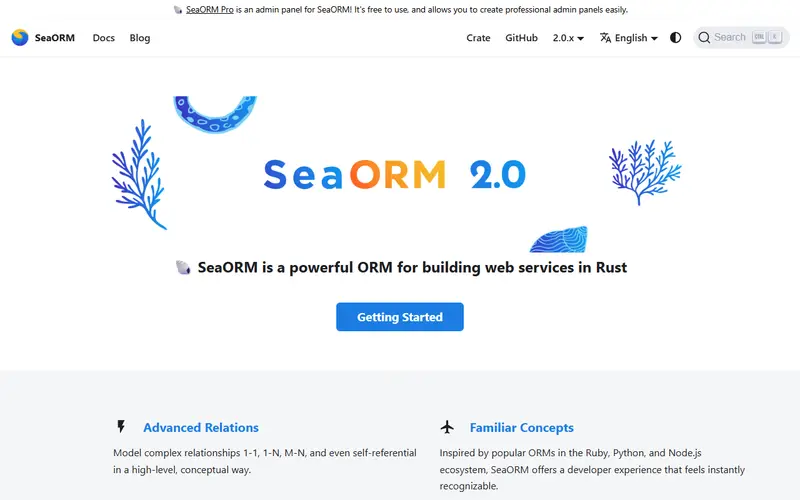
Overview
SeaORM was first released in 2021 by the SeaQL team as an async ORM on top of their SeaQuery query builder and SQLx. Entities are Rust structs with derive macros and attributes for primary keys, uniqueness and relations (has_one, has_many, belongs_to, many-to-many via a junction). sea-orm-cli can generate entity files from an existing database.
SeaORM 2.0 was released on 20 July 2026 after 43 release candidates. It introduced a denser entity format, a smart entity loader that uses joins for one-to-one and batched loading for one-to-many relations to avoid N+1 queries, nested ActiveModel builders that save a whole object graph in one call, an entity-first workflow, role-based access control, and moved to SeaQuery 1.0 and SQLx 0.9. The 1.0 API remains available for gradual migration.
SeaORM Pro is an admin panel generated from your entities; it is free, with a paid Pro Plus tier for sponsors that adds RBAC, notifications and the frontend source.
Pricing and plans
| Plan | Price | What you get |
|---|---|---|
| SeaORM | $0 | Dual-licensed: MIT or Apache 2.0 |
| SeaORM Pro | $0 | Admin panel; backend MIT, frontend closed source |
| SeaORM Pro Plus | Pro-tier GitHub sponsorship | RBAC, notifications and frontend source; sponsorship amount not stated on the page read |
What it does
- Async on SQLx
- All queries are async and run on SQLx drivers with tokio or other runtimes.
- Smart entity loader
- Loads nested relations with joins or batched queries to avoid N+1 queries.
- Nested ActiveModel
- Insert or update a user with profile, posts and tags in one save, ordered automatically.
- Entity generation
- sea-orm-cli generates entity files from an existing database.
- Framework examples
- Official examples for Axum, Actix, Rocket, Poem, Salvo, Tonic, Loco and GraphQL via Seaography.
Strengths and limitations
Strengths
- Async-first, fits modern Rust web frameworks
- Dynamic queries are easy to build at run time, unlike fully compile-time DSLs
- Batteries included: pagination, filters, nested writes, admin panel
- Active team with a long release-candidate process before breaking releases
Limitations
- 2.0 changed how entities and relations are written, so upgrades from 1.x need code changes
- Fewer compile-time guarantees on queries than Diesel
- Supports only PostgreSQL, MySQL/MariaDB and SQLite
- Pro Plus features of the admin panel require a paid sponsorship
Who it suits
Good for
- Async Rust web APIs
- Projects using the Loco framework
- Teams coming from ORMs in dynamic languages
Look elsewhere if
- Teams that want maximum compile-time checking (Diesel or SQLx macros)
- Synchronous applications
Pricing history
-
SeaORM 2.0 stable
SeaORM 2.0.0 shipped after 43 release candidates with a new entity format, smart entity loader, nested ActiveModel, RBAC, SeaQuery 1.0 and SQLx 0.9 (announced 27 July 2026). Source ↗
Alternatives to SeaORM
| Tool | From | Free option | Stages |
|---|---|---|---|
| Bun (Go ORM) SQL-first Go ORM | — | ||
| Kysely Type-safe TypeScript SQL query builder | — | ||
| SQLAlchemy Python SQL toolkit and ORM | — | ||
| Diesel Compile-time checked Rust ORM and query builder | — | ||
| Dapper .NET micro-ORM | — | ||
| Prisma ORM Schema-first TypeScript ORM | $10/mo | Free tier |
Questions
Is SeaORM async?
Yes, it is built on SQLx and all database calls are async.
When was SeaORM 2.0 released?
SeaORM 2.0.0 was released on 20 July 2026 and announced on 27 July 2026.
Is SeaORM Pro free?
Yes, the admin panel is free to use; Pro Plus features and frontend source come with a Pro-tier sponsorship.
Sources read for this page