Overview
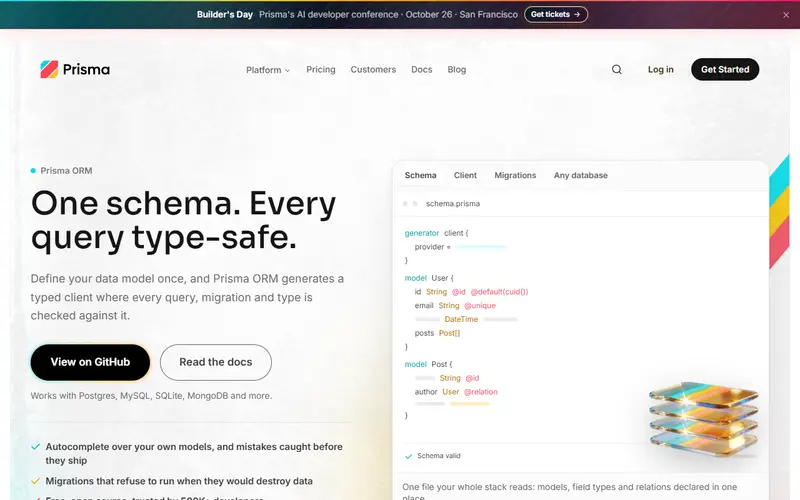
Prisma ORM is the most widely adopted schema-first ORM in the TypeScript world. You describe models and relations in a schema.prisma file, run prisma generate to get a typed client, and use Prisma Migrate to turn schema changes into SQL migration files. Queries are written as objects (findMany with where, include, select), so a misspelled field fails at type-check time.
Prisma 7 (November 2025) made the Rust-free client the default: the query engine binary is gone, replaced by a TypeScript and WebAssembly query compiler, which Prisma says cut bundle size by about 90% and made edge deployment on Cloudflare Workers and Vercel Edge simpler. Version 7 also requires explicit driver adapters, a prisma.config.ts file and an explicit output path for the generated client.
Prisma 8, a contract-first rewrite, is a release candidate with general availability expected in October 2026. Its docs say plain npm install prisma now installs the version 8 command-line tool, which does not read schema.prisma, so Prisma 7 projects should pin prisma@7. Prisma 7 gets fixes for 18 months after 8 ships; Prisma 6 gets security patches until 19 November 2026.
The ORM is free. Prisma earns money from Prisma Postgres and Prisma Compute, which have a free plan and paid plans from $10 a month, but the ORM works with any database host.
Pricing and plans
Free tier · no card
The ORM itself is free and open source (Apache 2.0). Prisma's hosted Free plan adds 200k Postgres operations, 500 MB storage and 1M Compute requests a month with no card.
At the limit Stops at the limit The hosted Free plan is a hard cap; the open-source ORM has no limits.
| Plan | Price | What you get |
|---|---|---|
| Prisma ORM | $0 | Open source; free on every Prisma plan |
| Free (hosted) | $0 | Prisma Postgres 200k operations, 500 MB; Prisma Compute 1M requests |
| Starter | $10/mo | 1M Postgres operations, 10 GB, 5M Compute requests, spend limits |
| Pro | $49/mo | 10M operations, 50 GB, 20M requests, HIPAA |
| Business | $129/mo | 50M operations, 100 GB, 100M requests, SOC 2, ISO 27001 |
What it does
- Declarative schema
- Models, fields, relations and enums in one schema.prisma file that drives both the client and migrations.
- Generated typed client
- Queries such as findMany, create and upsert are fully typed against your models, including nested relations.
- Prisma Migrate
- Generates SQL migration files from schema changes and warns before destructive changes.
- Rust-free runtime
- Since 6.16 (default in 7) queries are planned by a TypeScript/WASM compiler and run through driver adapters, with no native binary.
- TypedSQL and raw SQL
- Write .sql files and get typed functions, or use tagged raw queries when the query API is not enough.
- Prisma Studio
- A local data browser and editor started with npx prisma studio.
Strengths and limitations
Strengths
- Readable schema file that doubles as documentation of the data model
- Wide database coverage, including MongoDB and SQL Server, from one API
- Mature migration tooling and a large ecosystem of guides and integrations
- No native binary since version 7, so it deploys to edge runtimes
- Free to use with any host; no lock-in to Prisma's paid database
Limitations
- Prisma 8 is a rewrite in release candidate; its docs list missing features such as $extends, JSON filtering, atomic increment and most nested writes
- npm install prisma now installs the version 8 CLI, so version 7 projects must pin prisma@7
- Version 7 was a breaking upgrade: driver adapters, prisma.config.ts and an explicit client output path are required and the postinstall generate hook was removed
- Prisma 8 supports PostgreSQL, SQLite and MongoDB only; MySQL is not supported yet
- You must run prisma generate after every schema change
Who it suits
Good for
- TypeScript apps that want typed queries without writing SQL
- Teams that value a single, readable schema file
- Projects on Postgres, MySQL, SQL Server or MongoDB that may switch database later
Look elsewhere if
- Developers who prefer writing SQL directly (Kysely, Drizzle or sqlc fit better)
- Teams that cannot absorb a major rewrite in the next year
Pricing history
-
Prisma 8 enters release candidate
Prisma published v8.0.0-rc.1, a contract-first rewrite; GA is expected in October 2026. The plain prisma npm package now installs the v8 CLI, so Prisma 7 projects must pin prisma@7; Prisma 7 is supported for 18 months after 8 ships. Source ↗
-
Prisma 7 makes the Rust-free client the default
Prisma ORM 7.0.0 made the TypeScript query compiler default, requires driver adapters and prisma.config.ts, generates the client outside node_modules and removed the postinstall generate hook. Prisma 6 gets security patches until 19 November 2026. Source ↗
-
Rust-free Prisma ORM generally available (6.16)
Prisma 6.16 made the Rust-free query compiler and the ESM-first prisma-client generator production-ready as an opt-in. Source ↗
-
Prisma announces move from Rust engine to TypeScript
Prisma announced it would replace the Rust query engine with a TypeScript/WASM query compiler, cutting bundle size and native-binary deployment issues (announcement date). Source ↗
Alternatives to Prisma ORM
Questions
Is Prisma ORM free?
Yes. Prisma ORM is open source and free with any database; only Prisma's hosted Postgres and Compute products are paid.
Does Prisma still use a Rust engine?
No. Prisma 7 made the Rust-free TypeScript/WASM query compiler the default, and it has been production-ready since 6.16.
Should I use Prisma 7 or Prisma 8?
Prisma 8 is a release candidate with GA expected in October 2026 and missing features; Prisma 7 is supported for 18 months after 8 ships, so pin prisma@7 for existing apps.
Which databases does Prisma support?
PostgreSQL, MySQL, MariaDB, SQLite, SQL Server, CockroachDB and MongoDB in Prisma 7, plus managed services such as Neon, PlanetScale and Cloudflare D1 (preview).
Sources read for this page