Overview
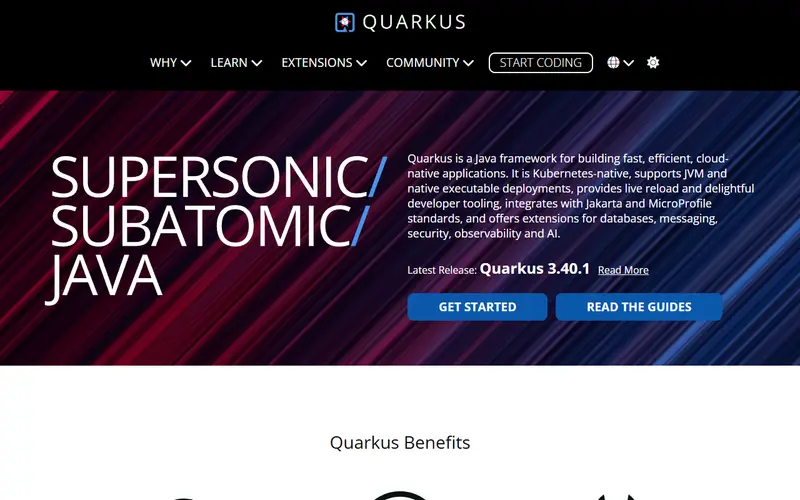
Quarkus is a cloud-native, container-first framework for Java applications. Its central idea is compile-time boot: it precomputes metadata and optimises class loading during the build, so there is less to do at runtime. The result is fast startup and low resident memory on the JVM, and even more so as a GraalVM native executable, which suits Kubernetes and scale-to-zero platforms.
Developers get a unified configuration, zero-config dev services and live reload in dev mode. The programming model unifies imperative and reactive styles on a Vert.x-based reactive core, and it builds on standards and libraries Java teams already use: RESTEasy and JAX-RS, Hibernate ORM and JPA, Netty, Eclipse MicroProfile and Apache Camel, among more than fifty integrated libraries.
Quarkus began at Red Hat and has moved to the Commonhaus Foundation to give other organisations equal footing. The project says the move addresses the perception that it was overly dependent on a single vendor, and aims for a broad base of contributors from multiple organisations.
Releases are frequent, with regular maintenance releases, and migration notes are collected in the project's migration guides.
Pricing and plans
What it does
- Build-time optimisation
- Compile-time boot reduces startup time and memory.
- Native executables
- GraalVM native images for very fast startup.
- Dev mode
- Live reload and zero-config dev services.
- Standards-based
- JAX-RS, JPA/Hibernate, MicroProfile, Vert.x and Camel.
- Imperative and reactive
- One model for blocking and non-blocking code.
- Kubernetes integration
- Tooling and extensions for container and Kubernetes deployment.
Strengths and limitations
Strengths
- Fast startup and low memory for Java
- Uses Java standards teams already know
- Neutral foundation governance
- Good fit for Kubernetes and serverless
Limitations
- Native executables depend on GraalVM, adding a separate build path to test
- Smaller ecosystem and hiring pool than Spring Boot
- Frequent releases mean regular upgrades; the project keeps migration guides for moving between versions
- Its Kubernetes and container focus adds less value for traditional long-running servers, which one quoted user noted
Who it suits
Good for
- Java microservices on Kubernetes
- Serverless or scale-to-zero Java workloads
- Teams wanting Java standards with fast startup
Look elsewhere if
- Teams deeply invested in Spring-specific libraries
- Non-JVM teams
Alternatives to Quarkus
| Tool | From | Free option | Stages |
|---|---|---|---|
| Laravel Batteries-included PHP framework | $5/mo | ||
| Fastify High-performance Node.js web framework | — | ||
| Symfony Full-stack PHP framework and components | — | ||
| Ruby on Rails Full-stack Ruby web framework | — | ||
| Actix Web Rust web framework | — | ||
| Django Batteries-included Python web framework | — |
Questions
Quarkus or Spring Boot?
Quarkus focuses on build-time optimisation and native images for fast startup; Spring Boot has the larger ecosystem.
Is Quarkus owned by Red Hat?
It started at Red Hat and moved to the Commonhaus Foundation to be vendor-neutral.
Does Quarkus support native images?
Yes, through GraalVM.
Is Quarkus free?
Yes, it is Apache-2.0 licensed.
Sources read for this page