Overview
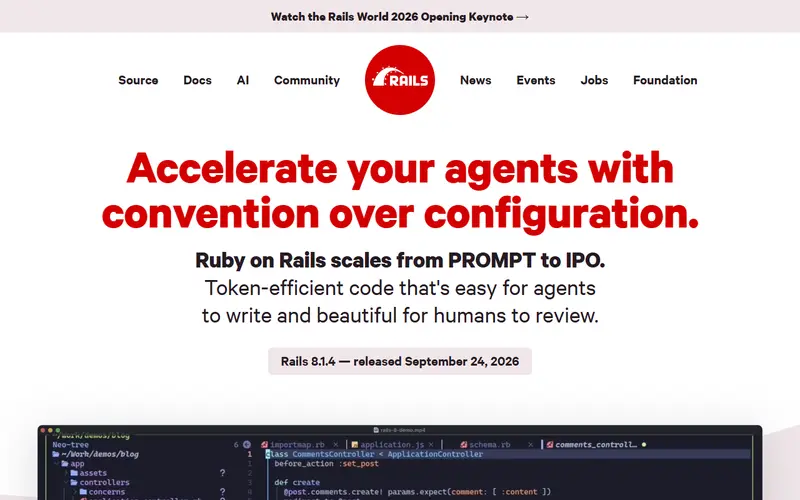
Ruby on Rails is a full-stack web framework built around convention over configuration. It includes Active Record for modelling databases with associations, callbacks and encryption; Action Controller for requests and caching headers; Action View templates; routing that exposes resources; mail sending and receiving; WebSockets for live pages; background jobs; and cloud file storage, plus protections against common attacks.
Rails was created by David Heinemeier Hansson and has been in use for about two decades. Its site says more than six thousand people have contributed code and that hundreds of thousands of apps have been built with it. The project now also pitches its conventions as a good fit for AI coding agents, because predictable structure keeps generated code maintainable.
The Rails Foundation, a US non-profit founded in 2022 and funded by core member companies such as Shopify, GitHub and 37signals, works on documentation, education, marketing and events and administers the Rails trademarks. DHH chairs its board.
There is no commercial edition. Deployment is up to you: any host that runs Ruby works.
Pricing and plans
What it does
- Active Record
- ORM with associations, callbacks, encryption, scopes and migrations.
- Action Cable
- WebSockets for live-updating pages.
- Active Job
- Enqueue background jobs for asynchronous work.
- Active Storage
- Attach uploads stored in cloud services to models.
- Action Mailer and Mailbox
- Send and receive email.
- Resourceful routing
- A routing DSL that maps resources to standard controller actions.
Strengths and limitations
Strengths
- Very fast path from idea to working product
- Strong conventions make codebases predictable
- Mature ecosystem of gems and long production history
- Foundation-backed documentation and events
Limitations
- Ruby only; teams must hire or train Ruby developers
- Conventions are strong; going against them adds friction
- Views mix Ruby and HTML by design, which teams wanting a separate SPA must work around (for example by building a JSON API)
- No official hosting or paid support; you choose your own deployment and vendors
Who it suits
Good for
- Startups building a product quickly with a small team
- Database-backed web apps and SaaS
- Teams that value conventions over configuration
Look elsewhere if
- Teams without Ruby experience or plans to hire it
- Tiny single-purpose APIs
Pricing history
-
Rails 8.1 released
Released 22 October 2025 with job continuations, structured event reporting and local CI, from over 500 contributors across 2,500 commits. Source ↗
Alternatives to Ruby on Rails
| Tool | From | Free option | Stages |
|---|---|---|---|
| Laravel Batteries-included PHP framework | $5/mo | ||
| FastAPI Python API framework | $20/mo | Free tier | |
| ASP.NET Core .NET web framework | — | ||
| Encore Backend framework with infrastructure from code | $49/mo | Free tier | |
| Gin Go HTTP web framework | — | ||
| Fastify High-performance Node.js web framework | — |
Questions
Is Ruby on Rails still used?
Yes. Rails releases continue (8.1.x in September 2026) and the Rails Foundation is backed by companies such as Shopify and GitHub.
Is Rails free?
Yes, it is MIT licensed.
Who maintains Rails?
The Rails core team and thousands of contributors; the Rails Foundation supports docs, education and events.
Does Rails include background jobs?
Yes, through Active Job.
Sources read for this page