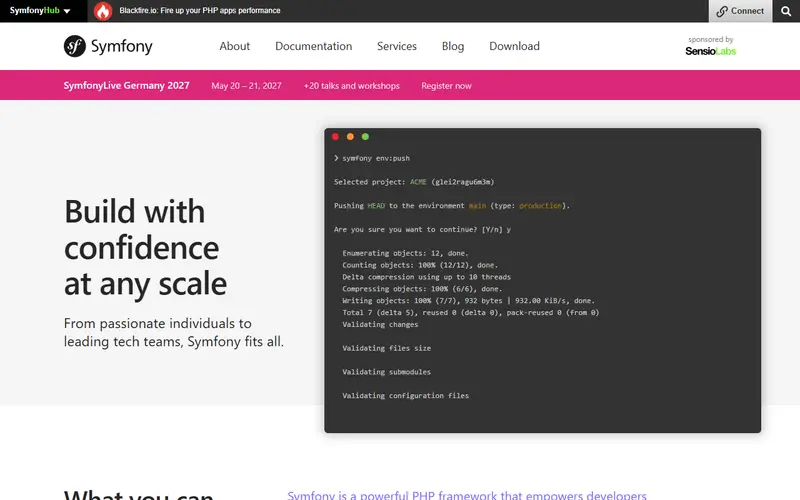
Overview
Symfony is a PHP framework and a collection of standalone components. As a full-stack framework it offers security, routing, Twig templates, ORM integration through Doctrine, validation, email, a console and testing tools. Its components are used on their own by projects such as Drupal, Laravel, API Platform and Composer.
The project follows a strict, time-based release model: minor versions every six months (May and November) and a major version every two years. Long-term support versions get three years of bug fixes and an extra year of security fixes; 7.4 LTS (November 2025) is supported for bugs until November 2028 and security until November 2029. Current 8.x releases require PHP 8.4.
For APIs, Symfony pairs with API Platform; for interactive front ends, Symfony UX adds Turbo and Stimulus. The Symfony book, The Fast Track, and SymfonyCasts cover learning.
Symfony was created by SensioLabs, which still backs it and sells training, consulting and SymfonyInsight. SymfonyCloud hosting is powered by Upsun. Each release also lists corporate backers.
Pricing and plans
| Plan | Price | What you get |
|---|---|---|
| Framework | Free | Open source (MIT) |
| SymfonyCloud, SymfonyInsight, services | See vendor | Hosting powered by Upsun, code-quality service and SensioLabs consulting; prices not read |
What it does
- Reusable components
- Hundreds of decoupled packages (HttpFoundation, Console, Routing and more) usable without the framework.
- Security
- Authentication, authorisation and a published security process with long-term fixes.
- Twig and Doctrine
- Templating with Twig and ORM integration with Doctrine.
- API Platform
- Build REST and GraphQL APIs on top of Symfony.
- Symfony UX
- Turbo and Stimulus integrations for interactive pages with little JavaScript.
- Predictable releases
- Minor every six months, major every two years, LTS with three years of bug fixes.
Strengths and limitations
Strengths
- Predictable release and support calendar for long-lived apps
- Components are an industry standard across PHP
- Strong fit for large, structured business applications
- Commercial backing and support from SensioLabs
Limitations
- Non-LTS versions are supported for only about eight months, so you either upgrade every six months or stay on LTS
- Current 8.x releases require PHP 8.4
- The symfony.com site says LTS versions are harder to upgrade from and lack the latest features
- More configuration and concepts to learn than Laravel for small projects
Who it suits
Good for
- Enterprise PHP applications with long lifecycles
- APIs built with API Platform
- Teams that want predictable upgrades and LTS
Look elsewhere if
- Quick prototypes where Laravel's conventions are faster
- Teams not using PHP
Alternatives to Symfony
| Tool | From | Free option | Stages |
|---|---|---|---|
| Spring Boot Java and Kotlin application framework | — | ||
| Django Batteries-included Python web framework | — | ||
| NestJS Structured TypeScript server framework | $12/mo | ||
| Encore Backend framework with infrastructure from code | $49/mo | Free tier | |
| Actix Web Rust web framework | — | ||
| Fastify High-performance Node.js web framework | — |
Questions
Is Symfony free?
Yes, it is MIT licensed. SensioLabs sells optional hosting, analysis, training and services.
How long is Symfony LTS supported?
Three years of bug fixes and security fixes for a further year; 7.4 LTS has security fixes until November 2029.
Does Laravel use Symfony?
Yes. Symfony lists Laravel among projects that use its components.
How often is Symfony released?
Minor versions every six months in May and November; major versions every two years.
Sources read for this page