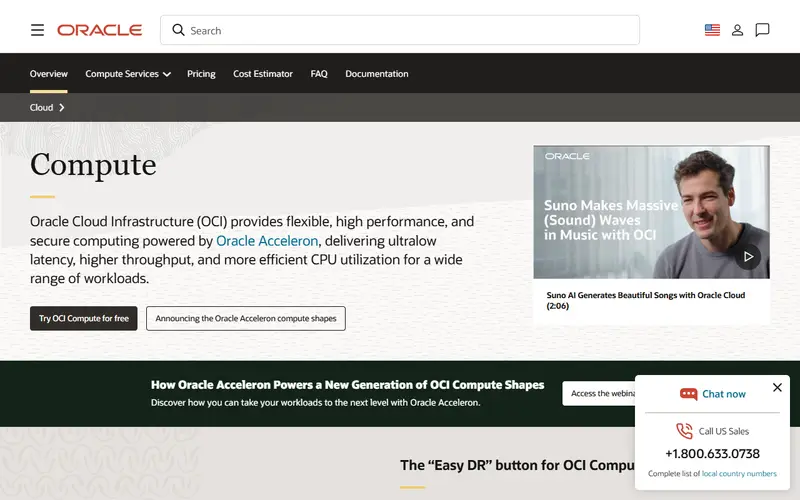
Overview
Oracle Cloud Infrastructure (OCI) Compute offers virtual machines and bare metal on AMD, Intel and Ampere Arm processors. Most shapes are 'flex' shapes: you choose the number of OCPUs and the amount of memory, and pay for each by the hour. One OCPU is a physical core, equal to two vCPUs on x86.
OCI is best known for its Always Free tier, which is available on free and paid accounts for as long as the account exists. It includes two AMD micro VMs, Ampere A1 capacity and 200 GB of block storage. On 15 June 2026 Oracle halved the A1 allowance from 4 OCPUs and 24 GB RAM to 2 OCPUs and 12 GB, without a public announcement.
Free resources come with conditions: they must be in your home region, capacity is often short, and Oracle may reclaim instances that stay below 20% CPU, network and memory use over seven days. For paid use, OCI competes on price with other hyperscalers and is a natural fit for teams running Oracle Database or Autonomous Database.
Pricing and plans
Free tier · card required
Always Free: two VM.Standard.E2.1.Micro instances (1/8 OCPU, 1 GB RAM, 50 Mbps), Ampere A1 Arm capacity of 1,500 OCPU hours and 9,000 GB hours per month (2 OCPUs and 12 GB RAM), and 200 GB of block volume storage, all in your home region. Idle instances may be reclaimed.
At the limit Not stated A Free Tier account is never charged; use past Always Free is billed only after you upgrade to Pay As You Go.
Paused if unused| Plan | Price | What you get |
|---|---|---|
| Always Free | $0 | 2 AMD micro VMs, 2 Ampere A1 OCPUs and 12 GB RAM, 200 GB block storage, in the home region |
| Free Trial | $300 credit | Credit for all OCI services, valid for 30 days in select countries |
| Pay As You Go | Usage-based | Billed per OCPU-hour and GB-hour of memory above the Always Free amounts |
What it does
- Always Free compute
- Two AMD micro VMs plus 2 Ampere A1 OCPUs and 12 GB RAM, free for the life of the account.
- Flexible shapes
- Pick OCPU count and memory separately on flex shapes, and resize later.
- Arm instances
- Ampere A1 and newer Arm shapes for Arm-native workloads.
- 200 GB free block storage
- Always Free block volume storage for boot and data volumes; minimum boot volume is 47 GB.
- Free networking extras
- Always Free includes a flexible load balancer, site-to-site VPN, bastions and virtual cloud networks.
- $300 trial
- New accounts get $300 of credit for 30 days in select countries.
Strengths and limitations
Strengths
- The largest permanent free compute allowance among the big clouds.
- Always Free resources stay free after upgrading to a paid account.
- Flexible shapes let you size CPU and memory independently.
- Close integration with Oracle Database and Autonomous Database.
Limitations
- Oracle halved the Always Free Arm allowance on 15 June 2026 without notice.
- Free-tier capacity is often unavailable ('out of host capacity') in popular regions.
- Idle Always Free instances can be reclaimed after seven days of low use.
- Always Free AMD micro VMs have 1/8 OCPU, 1 GB RAM and 50 Mbps internet bandwidth.
- Signup rejects prepaid, virtual and PIN debit cards.
Who it suits
Good for
- A free personal server or VPN
- Arm experimentation and small self-hosted apps
- Companies already on Oracle Database
Look elsewhere if
- Production apps that rely on free-tier capacity
- Users who want simple flat-rate server bills
Pricing history
-
Oracle halves Always Free Ampere A1 allowance
Around 15 June 2026 Oracle updated its documentation to cut the Always Free Ampere A1 allowance from 3,000 OCPU hours and 18,000 GB hours (4 OCPUs, 24 GB RAM) to 1,500 and 9,000 (2 OCPUs, 12 GB RAM), without a public announcement. Source ↗
Alternatives to Oracle Cloud Infrastructure Compute
| Tool | From | Free option | Stages |
|---|---|---|---|
| Google Compute Engine Hyperscaler compute | $6.11/mo | Free tier | |
| Scaleway Instances Cloud VPS | €6.55/mo | ||
| DigitalOcean Droplets Cloud VPS | $4/mo | ||
| Akamai Cloud (Linode) Cloud VPS | $5/mo | ||
| Vultr Cloud Compute Cloud VPS | $2.50/mo | ||
| UpCloud Cloud Servers Cloud VPS | €3/mo |
Questions
What does Oracle Cloud's Always Free tier include?
Two AMD micro VMs, Ampere A1 Arm capacity equal to 2 OCPUs and 12 GB RAM, and 200 GB of block storage, all in your home region for the life of the account.
Did Oracle reduce the free Ampere A1 limits?
Yes. On 15 June 2026 the allowance fell from 3,000 OCPU hours and 18,000 GB hours (4 OCPUs, 24 GB) to 1,500 and 9,000 (2 OCPUs, 12 GB).
Why can't I create an Always Free instance on Oracle Cloud?
An 'out of host capacity' error means free shapes are temporarily unavailable in your home region; try another availability domain or later.
Will Oracle delete my free VM?
Oracle may reclaim Always Free instances that are idle, meaning 95th-percentile CPU, network and (for A1) memory use below 20% over seven days.
Sources read for this page