Overview
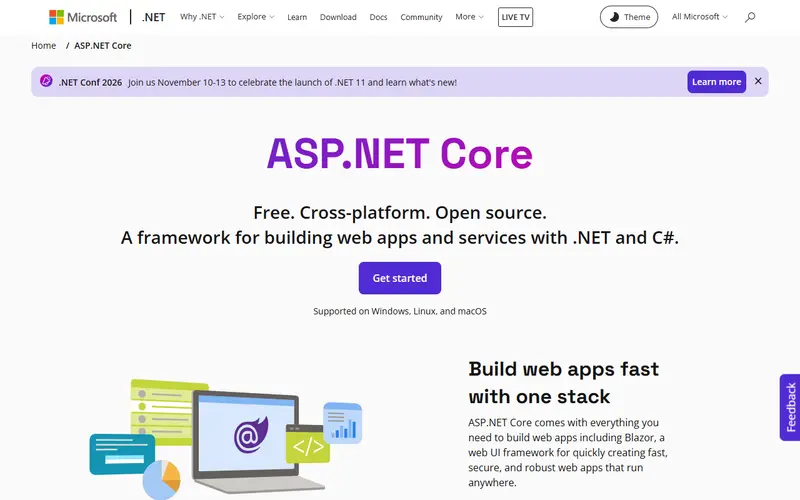
ASP.NET Core is a cross-platform, high-performance, open-source framework for building web apps and services with .NET and C#. It runs on Windows, Linux and macOS and deploys to any major cloud, your own servers or hosting providers.
The framework includes a lightweight modular request pipeline, the Kestrel HTTP server, integrated dependency injection, environment-based configuration and rich logging, tracing and metrics. Minimal APIs declare fast web APIs with little code; MVC and Razor serve larger apps; Blazor builds interactive web UI in C# without JavaScript; SignalR adds real-time communication; gRPC offers high-performance RPC. Security features cover authentication, authorisation, data protection, XSS and CSRF, and a built-in user store supports multi-factor and external logins.
Microsoft cites the independent TechEmpower benchmarks (Round 23) as showing ASP.NET Core faster than any other popular web framework.
A new major .NET release ships every November. Even-numbered releases are LTS with three years of free support; odd-numbered releases are STS with two years. .NET 10 (November 2025) is the current LTS, supported until November 2028.
Pricing and plans
What it does
- Minimal APIs
- Declare routes and endpoints fluently with little code.
- Kestrel
- High-performance cross-platform HTTP server.
- Blazor
- Interactive web UI components in C#.
- SignalR and gRPC
- Real-time messaging and high-performance RPC.
- Identity and security
- Built-in user store, MFA, external logins, data protection, XSS and CSRF protections.
- Dependency injection
- Integrated DI and environment-based configuration.
Strengths and limitations
Strengths
- Very high performance in TechEmpower benchmarks
- Complete stack from APIs to UI (Blazor) in C#
- Predictable yearly releases with LTS
- Backed by Microsoft with first-class tooling
Limitations
- Tied to the .NET release cycle: LTS support lasts three years and STS two, so apps must move to new versions regularly
- Systems must stay on the latest patch to remain supported under Microsoft's policy
- C# and .NET only
- Microsoft's free Azure hosting offer and much of its tooling guidance centre on Azure and Visual Studio
Who it suits
Good for
- Enterprise APIs and web apps in C#
- Teams wanting one language for server and UI (Blazor)
- High-throughput services
Look elsewhere if
- Teams without .NET experience who want the smallest learning curve
- Very small scripts or edge functions
Pricing history
-
.NET 10 LTS released
.NET 10, including ASP.NET Core 10, was released on 11 November 2025 as a Long Term Support release supported until 14 November 2028. Source ↗
-
.NET STS releases now supported for 24 months
Announced 16 September 2025: Standard Term Support releases get 24 months instead of 18, starting with .NET 9, which now ends support on 10 November 2026. LTS stays at three years. Source ↗
Alternatives to ASP.NET Core
| Tool | From | Free option | Stages |
|---|---|---|---|
| Laravel Batteries-included PHP framework | $5/mo | ||
| Django Batteries-included Python web framework | — | ||
| FastAPI Python API framework | $20/mo | Free tier | |
| Encore Backend framework with infrastructure from code | $49/mo | Free tier | |
| Gin Go HTTP web framework | — | ||
| Fastify High-performance Node.js web framework | — |
Questions
Is ASP.NET Core free?
Yes. It is free and open source, and runs on Windows, Linux and macOS.
Which .NET version should I use?
The current LTS, .NET 10, is supported until November 14, 2028.
Does ASP.NET Core run on Linux?
Yes. It is cross-platform.
How long is .NET STS supported?
Two years, since Microsoft extended STS support from 18 to 24 months starting with .NET 9.
Sources read for this page