Overview
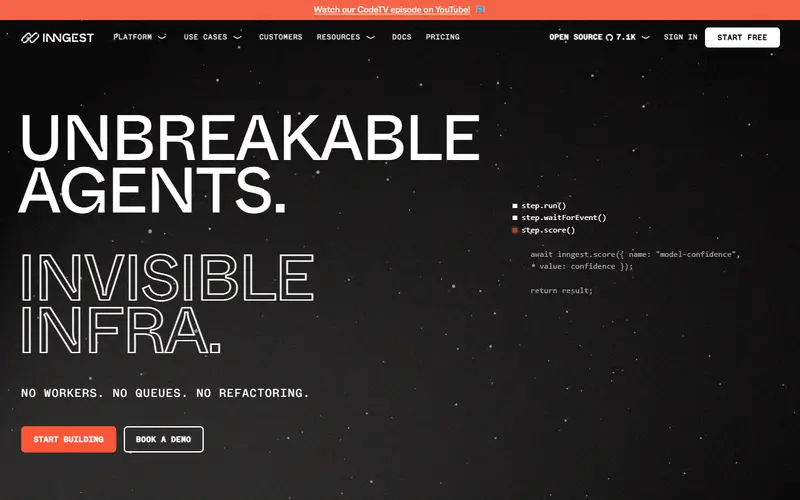
Inngest replaces a queue plus workers with durable functions that live in your application. You send an event (or set a cron trigger), Inngest schedules a run and calls your function over HTTPS; each step.run() result is saved, so a failure retries only the failed step rather than the whole job. Functions can sleep, wait for another event, fan out and be cancelled by events.
Pricing counts executions: one for the run and one for each step. The free plan includes 50,000 executions and 500,000 events a month with only 5 concurrent steps, and stops executing at the quota rather than billing. Pro starts at $99 a month for 1 million executions and 100+ concurrent steps, with metered overage; Business starts at $499 for 10 million.
Flow control is the distinctive part: concurrency keyed by user or tenant, throttling, rate limits, debouncing, prioritisation and batching are declared on the function. Newer releases add agent tooling, realtime streaming and trace scores.
Inngest can be self-hosted as one binary (SQLite and in-memory Redis by default, or external Postgres and Redis), but the vendor does not offer support for self-hosted instances outside enterprise deals. Cloud data is hosted in the United States.
Pricing and plans
Free tier · no card
50,000 executions a month, 500,000 events, 5 concurrent steps, 5 seats, 24-hour trace history; no card
At the limit Pauses On Free there is no metered overage: execution pauses once the monthly quota is used until you upgrade.
| Plan | Price | What you get |
|---|---|---|
| Free | $0 | 50k executions, 500k events, 5 concurrent steps, 5 seats, 24h traces |
| Pro | From $99/mo | 1M executions, 100+ concurrent steps, 15 seats, 5M events, 7-day traces |
| Business | From $499/mo | 10M executions, 500 concurrent steps, 30 seats, 50M events, 14-day traces |
| Enterprise | Custom | SAML, RBAC, audit trails, HIPAA included, 90-day traces, dedicated Slack |
What it does
- Durable steps
- step.run() results are persisted, failed steps retry on their own, and runs can sleep or wait for events for long periods.
- Flow control
- Per-key concurrency, throttling, rate limiting, debouncing, prioritisation and batching set in function options.
- Event and cron triggers
- Functions start from events, schedules or webhooks; one event can fan out to many functions.
- Local dev server
- npx inngest-cli dev discovers functions and gives a local dashboard with traces and logs.
- Serverless or connected workers
- Functions run on your existing serverless or server host; 'connect' workers keep an outbound connection for lower latency.
- Observability
- Traces per run and step, metrics, and evaluation scores; Datadog export is an add-on.
Strengths and limitations
Strengths
- No queue or worker infrastructure to run; functions deploy with your app
- Per-tenant concurrency and throttling built in
- SDKs for TypeScript, Python, Go and Kotlin/Java
- Free plan needs no card and does not bill past its quota
- SOC 2 Type II, with HIPAA available
Limitations
- Every step counts as an execution, so multi-step or agent workloads use the quota several times faster than the run count suggests
- Free plan allows only 5 concurrent steps and 24 hours of trace history
- Paid plans start at $99/mo with no smaller tier
- Self-hosted instances get no direct support from the vendor
- Cloud data is stored in the US only
Who it suits
Good for
- Serverless apps on Vercel, Netlify or Cloudflare that need long-running work
- Multi-tenant SaaS needing fair per-customer concurrency
- AI agent and LLM pipelines with many retried steps
Look elsewhere if
- Simple high-volume fire-and-forget jobs where a Redis or Postgres queue costs far less
- Teams that require EU data residency
Alternatives to Inngest
| Tool | From | Free option | Stages |
|---|---|---|---|
| DBOS Postgres-backed durable workflow library | $99/mo | ||
| Sidekiq Redis-based background job library for Ruby | $99/mo | ||
| River Postgres-backed job queue for Go | $125/mo | ||
| Oban SQL-backed job processing library for Elixir (and Python) | $135/mo | ||
| BullMQ Redis-based job queue library | $139/mo | ||
| Hangfire Background job library for .NET | $500/yr |
Questions
Is Inngest free?
Yes. The free plan includes 50,000 executions and 500,000 events a month with 5 concurrent steps and no card required.
What counts as an Inngest execution?
Each function run counts once and each step inside it counts once more, so a run with 5 steps uses 6 executions.
What happens when I hit the Inngest free limit?
Execution pauses once the free quota is used; there is no overage billing on Free, so you must upgrade to continue.
Can I self-host Inngest?
Yes, since version 1.0 the Inngest server runs as a single binary or Docker image, though the team does not guarantee support for self-hosted instances.
How much does Inngest Pro cost?
Pro starts at $99 a month with 1 million executions, then tiered overage from $0.00005 per execution.
Sources read for this page