Overview
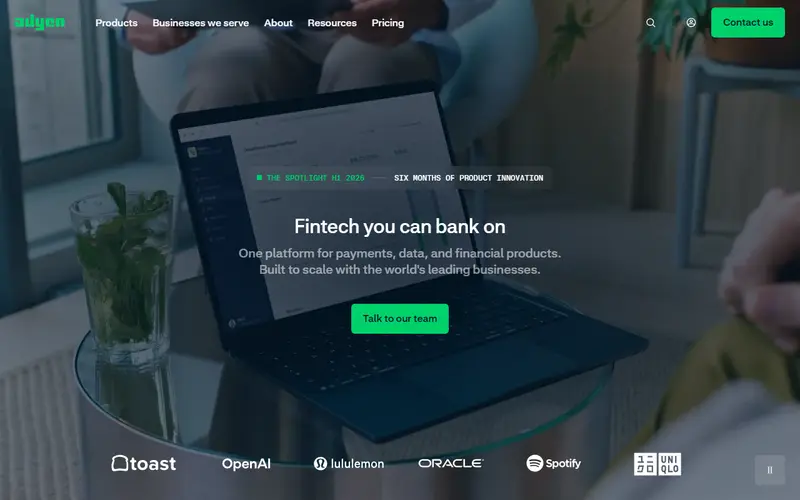
Adyen is a payment platform used by large retailers, travel companies and digital businesses. It combines gateway, risk management and acquiring in one company and holds banking licences in the US, UK and EU, which lets it settle funds itself rather than through partner banks in many markets.
Pricing is published per method. Each transaction pays a fixed $0.13 processing fee plus a method fee; for Visa and Mastercard that is interchange++ plus 0.60%, meaning you pay the card network's actual interchange and scheme fees plus Adyen's markup. For a typical US consumer credit card the total is often close to other processors, while EU debit cards with capped interchange can be much cheaper.
Recurring payments use Adyen's tokenization module to store card details, but Adyen does not include a subscription billing engine; businesses usually pair it with their own billing or a tool like Chargebee or Lago. Adyen is not a merchant of record.
Pricing and plans
| Plan | Price | What you get |
|---|---|---|
| Cards (Visa, Mastercard) | $0.13 + interchange++ + 0.60% | Interchange and scheme fees passed through at cost |
| American Express | $0.13 + 3.95% | Interchange++ in specific situations |
| Other methods | $0.13 + method fee | Each local method has its own fee on the pricing page |
What it does
- Interchange++ pricing
- Card scheme and interchange fees passed through at cost with a fixed markup, instead of a blended rate.
- Own acquiring
- Adyen acquires in regions including the US, Europe, Australia, Brazil, Canada, Hong Kong, India, Japan and Singapore.
- Online and in-person
- One platform for web, app and terminal payments with unified reporting.
- Tokenization
- Stores card details in the Adyen Vault for one-click and subscription payments and lowers PCI scope.
- Adyen for Platforms
- Embedded payments, accounts, card issuing and capital for marketplaces and SaaS platforms.
Strengths and limitations
Strengths
- Transparent interchange++ pricing that rewards low-cost card mixes
- Hundreds of local payment methods with published fees
- Single provider for online, in-person and platform payments
- US, UK and EU banking licences
Limitations
- Card costs vary with interchange, so there is no single flat rate to budget
- Aimed at large businesses; onboarding is sales-led
- No built-in subscription billing engine
- The $0.13 fixed fee applies to every transaction on top of method fees
Who it suits
Good for
- High-volume merchants selling in many countries
- Retailers unifying online and in-store payments
- Platforms embedding payments for their users
Look elsewhere if
- Side projects and early startups that need self-serve signup
- Sellers who want tax handled by a merchant of record
Alternatives to Adyen
| Tool | From | Free option | Stages |
|---|---|---|---|
| Paddle Merchant of record for software | Usage-based | ||
| Chargebee Subscription and usage billing | Usage-based | ||
| Orb Usage-based billing platform | — | ||
| Recurly Subscription billing (DTC and consumer) | $249/mo | ||
| Razorpay Payment gateway (India, plus US, Singapore, Malaysia) | Usage-based | ||
| FastSpring Merchant of record for software | — |
Questions
How does Adyen pricing work?
Each transaction costs a $0.13 processing fee plus a payment method fee; Visa and Mastercard are interchange++ plus 0.60%.
Does Adyen have a monthly fee?
The pricing page lists no setup or monthly fees; you pay per transaction.
Is Adyen good for small businesses?
It is built for large merchants and onboarding is sales-led, so small businesses usually start with Stripe, Mollie or a merchant of record.
Sources read for this page