Overview
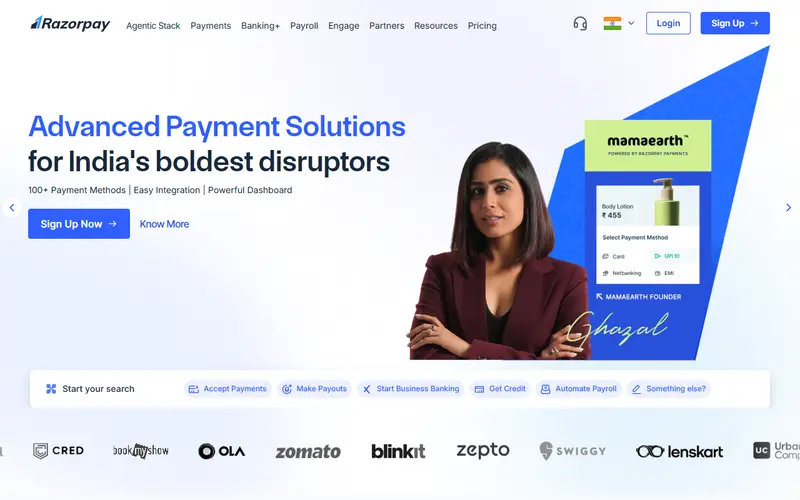
Razorpay is one of India's main payment gateways. A single integration accepts UPI, RuPay and other cards, netbanking across 72+ banks, wallets, pay-later and EMI, and settles on a T+1 or instant cycle.
Pricing in India is a flat 2% platform fee on every domestic instrument, with 18% GST on the fee and no setup or maintenance charges. International cards cost up to 3%. Subscriptions add 0.9% on card mandates. The RazorpayX side adds current accounts, payouts and payroll.
Razorpay also runs a US entity that processes cards at 2.70% + $0.30 and lets US companies collect INR payments from Indian customers without an Indian entity, plus operations in Singapore and Malaysia (Curlec). It is a processor, so you handle your own tax.
Before signing up, check GST treatment with your accountant, since the 18% GST applies to Razorpay's fee rather than to the sale. Businesses processing large volumes can move to custom or enterprise pricing.
Pricing and plans
| Plan | Price | What you get |
|---|---|---|
| India standard | 2% per transaction | All domestic instruments incl. UPI, cards, netbanking, wallets; 18% GST on the fee; no setup or annual fee |
| India international cards | Up to 3% | Inward payments from overseas customers |
| US standard | 2.70% + $0.30 | Cards; foreign cards +1.20%; ACH 0.50% capped at $5 |
| Enterprise | Custom | Custom rates for high volume |
What it does
- UPI and Indian methods
- UPI, RuPay, netbanking, wallets, cardless EMI and pay-later through one checkout.
- Subscriptions
- Recurring billing with card and UPI mandates and alerts on subscription activity.
- Payment links and pages
- No-code links, hosted pages and buttons for accepting payments without a website.
- Cross-border collection
- US merchants can accept Indian payment methods and settle in USD.
- RazorpayX
- Current accounts, bulk payouts, vendor payments and payroll.
Strengths and limitations
Strengths
- One flat 2% rate across Indian payment methods with no setup fee
- Deep coverage of UPI and other Indian methods
- Payments, payouts and banking in one account
- Machine-readable pricing files that are easy to check
Limitations
- GST of 18% applies on top of the 2% fee in India
- International cards on Indian accounts cost up to 3%
- UPI subscription pricing is only on request
- Not a merchant of record; the US entity does not collect sales tax for you
Who it suits
Good for
- Indian startups and SaaS companies selling domestically
- US companies wanting to collect from Indian buyers
- Businesses that need UPI Autopay subscriptions
Look elsewhere if
- European businesses (see Mollie or Stripe)
- Global digital sellers who want tax handled for them
Alternatives to Razorpay
| Tool | From | Free option | Stages |
|---|---|---|---|
| Stripe Payments Payment processor (API-first) | Usage-based | ||
| Paddle Merchant of record for software | Usage-based | ||
| Square Payments Payment processor (in-person and online) | Usage-based | ||
| Mollie Payment processor (Europe) | Usage-based | ||
| Lago Open-source usage-based billing | — | ||
| Stripe Billing Subscription billing | Usage-based |
Questions
What does Razorpay charge in India?
A flat 2% platform fee per successful domestic transaction, plus 18% GST on the fee, with no setup or annual charges.
Is Razorpay available in the US?
Yes. Razorpay's US entity processes cards at 2.70% + $0.30 and ACH at 0.50% capped at $5.
Does Razorpay support subscriptions?
Yes. Card subscriptions cost 0.9% plus the platform fee in India; UPI subscription pricing is on request.
Sources read for this page