Overview
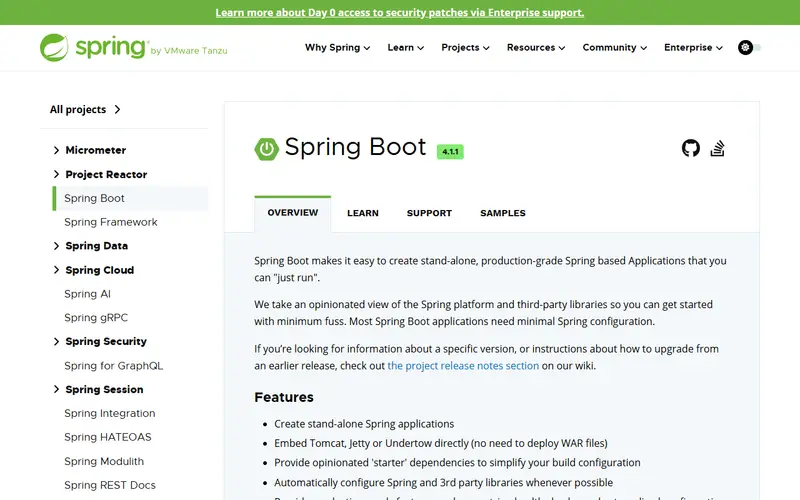
Spring Boot makes it easy to create stand-alone, production-grade Spring applications that you can just run. It takes an opinionated view of the Spring platform: starter dependencies bring in compatible libraries, auto-configuration sets up Spring and third-party components whenever possible, and an embedded Tomcat, Jetty or Undertow removes the need to deploy WAR files. There is no code generation and no XML configuration requirement.
Production features such as metrics, health checks and externalised configuration are built in. Spring Initializr generates new projects, and the wider Spring portfolio covers data access, security, batch, messaging, GraphQL and cloud patterns.
Spring Boot 4.0 (November 2025) began a new generation on Spring Framework 7, with a modularised codebase, JSpecify null safety, first-class Java 25 support while keeping Java 17 compatibility, API versioning and HTTP service clients. A migration guide covers the move from 3.5.
Broadcom's Tanzu division stewards Spring; all committers for Spring Boot and Spring Framework are on the Tanzu team. Its paid Tanzu Spring subscription offers enterprise releases, extended support for versions past open-source end of life, compliance extensions and 24x7 support.
Pricing and plans
| Plan | Price | What you get |
|---|---|---|
| Spring Boot | Free | Open source |
| Tanzu Spring | Custom | Enterprise releases, extended support past OSS end of life, patches, Application Advisor, 24x7 support |
What it does
- Starters
- Opinionated dependency sets for web, data, security, messaging and more.
- Auto-configuration
- Configures Spring and third-party libraries based on what is on the classpath.
- Embedded servers
- Tomcat, Jetty or Undertow inside a runnable jar.
- Production features
- Metrics, health checks and externalised configuration.
- Spring Initializr
- Generate a new project with chosen dependencies.
- Tanzu Spring
- Paid extended support, patches and upgrade automation from Broadcom.
Strengths and limitations
Strengths
- Huge ecosystem covering almost every enterprise need
- Mature, widely known in enterprise hiring
- Commercial extended support available
- Works with Java and Kotlin
Limitations
- Major versions (such as 3 to 4) require migration work; the project publishes migration guides
- Support for versions past open-source end of life requires the paid Tanzu Spring subscription
- Auto-configuration and annotations hide a lot of behaviour, which takes time to learn
- Tanzu Spring pricing is not published; you must contact Broadcom
Who it suits
Good for
- Enterprise Java or Kotlin back ends
- Teams already invested in the Spring ecosystem
- Organisations needing vendor support contracts
Look elsewhere if
- Small hobby APIs where a lightweight framework is enough
- Teams wanting to avoid the JVM
Pricing history
-
Spring Boot 4.0 released
Released 20 November 2025 on Spring Framework 7: a modularised codebase, JSpecify null safety, first-class Java 25 support with Java 17 still supported, API versioning and HTTP service clients. Source ↗
Alternatives to Spring Boot
| Tool | From | Free option | Stages |
|---|---|---|---|
| Encore Backend framework with infrastructure from code | $49/mo | Free tier | |
| NestJS Structured TypeScript server framework | $12/mo | ||
| Actix Web Rust web framework | — | ||
| ASP.NET Core .NET web framework | — | ||
| Ruby on Rails Full-stack Ruby web framework | — | ||
| Laravel Batteries-included PHP framework | $5/mo |
Questions
Is Spring Boot free?
Yes. Broadcom sells optional Tanzu Spring support and extended releases.
What Java version does Spring Boot 4 need?
It retains Java 17 compatibility and adds first-class Java 25 support.
Who maintains Spring Boot?
The Spring team within Broadcom's Tanzu division, with community contributors.
Does Spring Boot need an application server?
No. It embeds Tomcat, Jetty or Undertow in the application.
Sources read for this page