Skip to content
whichdevtool?
Categories ▾

Frameworks and UI

Frontend and full-stack frameworks Backend frameworks UI component libraries

Hosting

VPS and cloud servers App hosting and PaaS

Data

Managed databases File and object storage ORMs and database toolkits

AI

AI model APIs

Email

Transactional email APIs Email marketing and newsletters

Payments

Payments and billing

Domains and edge

Domain registrars CDN, DNS and edge security

Operations and identity

Monitoring, uptime and error tracking Auth and identity Background jobs, queues and workflows
Stacks Directory
Ctrl K

Search directory
Menu
StacksDirectory Pricing changes Glossary
VPS and cloud servers App hosting and PaaS Managed databases Transactional email APIs Email marketing and newsletters Domain registrars CDN, DNS and edge security Monitoring, uptime and error tracking Auth and identity Frontend and full-stack frameworks Backend frameworks UI component libraries AI model APIs File and object storage Payments and billing Background jobs, queues and workflows ORMs and database toolkits
  1. Home
  2. Backend frameworks
  3. Ktor
Kt

Kotlin server and client framework · by JetBrains

Ktor

JetBrains' lightweight Kotlin framework for asynchronous servers and HTTP clients, built on coroutines, with a plugin pipeline and no imposed structure.

Visit ktor.io ↗ Alternatives Open source Open source Self-hostable
ktor.io
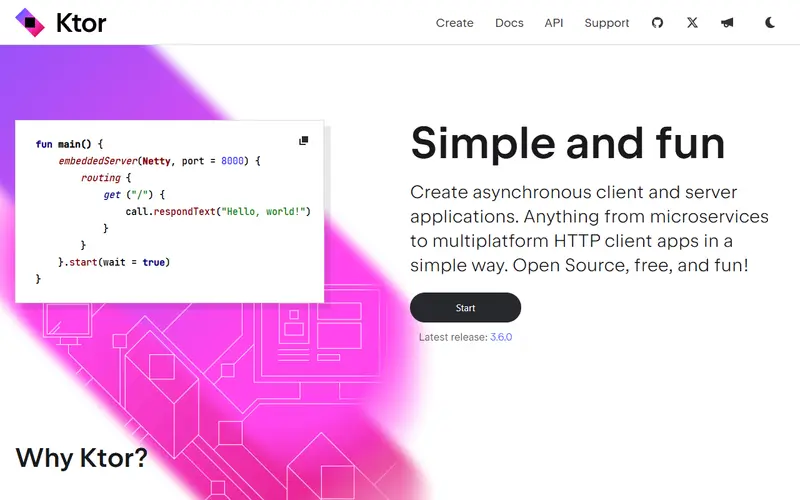
Ktor homepage
§1

Overview

Ktor is a framework for creating asynchronous client and server applications in Kotlin, from microservices to multiplatform HTTP clients. It is written in Kotlin from the ground up and uses coroutines, so asynchronous code reads like ordinary imperative code and host implementations avoid blocking threads.

It is unopinionated: Ktor does not impose choices for logging, templating, persistence, serialization or dependency injection. Features are installed as plugins through a unified interception pipeline, and routes are declared with a Kotlin DSL. Applications run standalone on Netty or Jetty or in a servlet container such as Tomcat.

Ktor apps can run in a test environment that emulates a server without real networking, which makes integration tests fast. A Gradle plugin and a project generator at start.ktor.io help set up projects.

Ktor is an official JetBrains product, used internally at JetBrains, with IDE support in IntelliJ IDEA. The repository dates from 2015 and the project is Apache-2.0 licensed.

§2

Pricing and plans

Free and open source under the Apache-2.0 licence. No paid edition.

Source: ktor.io/ · prices as published, excluding tax.

§3

What it does

Coroutines
Asynchronous I/O with Kotlin coroutines throughout.
Routing DSL
Declarative routes written in Kotlin.
Plugins
Install features through an interception pipeline; write your own easily.
Multiple engines
Netty, Jetty or Servlet 3.0+ containers.
Test host
Test applications without real networking.
Multiplatform client
The same project provides a Kotlin Multiplatform HTTP client.
§4

Strengths and limitations

Strengths

  • Backed and used by JetBrains, with strong IDE tooling
  • Lightweight compared with Spring Boot
  • Idiomatic Kotlin with coroutines
  • Fast in-memory testing

Limitations

  • Kotlin only; Java-first teams get little benefit
  • Unopinionated: persistence, DI and project structure are your choice and your work
  • Smaller ecosystem than Spring Boot for enterprise integrations
  • No built-in ORM or DI container; you pick and wire those libraries yourself
§5

Who it suits

Good for

  • Kotlin microservices and APIs
  • Teams that share Kotlin code between server and clients
  • Developers wanting a lighter JVM framework

Look elsewhere if

  • Java-only teams
  • Enterprises needing Spring's breadth of integrations
§6

Alternatives to Ktor

Tool From Free option Stages
Phoenix Elixir web framework
— Open source
En
Encore Backend framework with infrastructure from code
$49/mo Free tier
AJ
AdonisJS Batteries-included TypeScript MVC framework
— Open source
FastAPI Python API framework
$20/mo Free tier
Hono Web-standards TypeScript web framework
— Open source
ASP.NET Core .NET web framework
— Open source

All backend frameworks →

§7

Questions

Who makes Ktor?

JetBrains, the company behind Kotlin and IntelliJ IDEA.

Ktor or Spring Boot?

Ktor is lighter and Kotlin-native; Spring Boot offers a much larger ecosystem and more built-in integrations.

Is Ktor free?

Yes, it is Apache-2.0 licensed.

Can Ktor run on Tomcat?

Yes, in any Servlet 3.0+ container, or standalone on Netty or Jetty.

Sources read for this page

  • https://ktor.io/
  • https://github.com/ktorio/ktor
Spec sheet
From
Open source
Free tier
Free to self-host
Stages
HobbyIndieStartupScale-upEnterprise Suits hobby, indie, startup, scale-up
Language
Kotlin
Style
Minimal, unopinionated
Runs on
JVM (Netty, Jetty, servlet)
Maintained by
JetBrains
Open source
Yes
Self-host
Yes
EU data
Not stated
Category
Backend
Visit ktor.io ↗

To report an out-of-date price or limit, use the correction form.

whichdevtool?

Developer and cloud tools compared on price, free tier and limits, each with its source. For side projects, solo developers and small teams.

Categories

  • VPS and cloud servers
  • App hosting and PaaS
  • Managed databases
  • Transactional email APIs
  • Email marketing and newsletters
  • Domain registrars
  • CDN, DNS and edge security
  • Monitoring, uptime and error tracking
  • Auth and identity
  • Frontend and full-stack frameworks
  • Backend frameworks
  • UI component libraries
  • AI model APIs
  • File and object storage
  • Payments and billing
  • Background jobs, queues and workflows
  • ORMs and database toolkits

Research

  • Directory
  • Stacks by project
  • Developer news
  • Pricing changes
  • Glossary

Site

  • About and methods
  • How we make money
  • Suggest a tool or fix
  • Privacy
© 2026 whichdevtool.com Prices change. Each tool page links to its source. We may earn a commission when you sign up through links on this site. How we make money