Overview
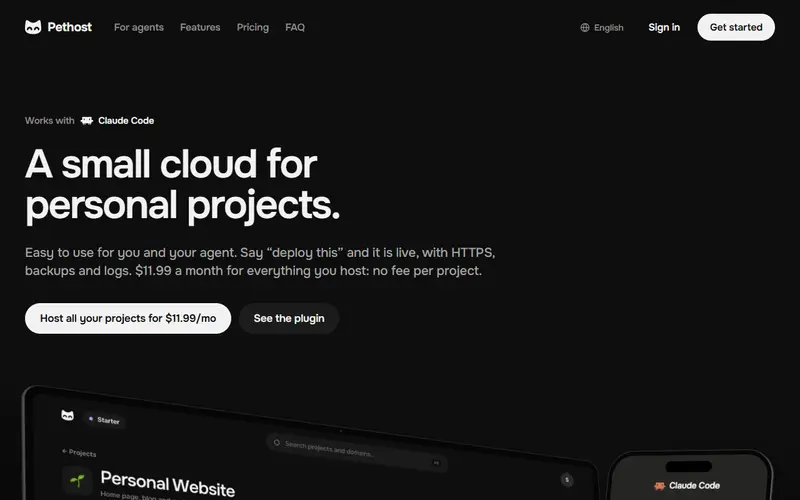
Pethost is an app host for personal projects and small applications. It manages a virtual machine for each account, including security updates, HTTPS, request logs and backups. Apps, workers and database containers run together within its capacity.
Deploy through GitHub or upload project files, then manage projects in the web panel or through an approved MCP agent. Database services live inside the project rather than a separate managed database product. The platform is intended for a single machine, without autoscaling or multi-region deployment.
Pricing and plans
| Plan | Price | What you get |
|---|---|---|
| Starter | $11.99/mo + tax | US pricing. 2 vCPU, 3 GB memory, 30 GB SSD; projects and databases share these resources. |
| Grow | $19.99/mo + tax | US pricing. 4 vCPU, 6 GB memory, 60 GB SSD; the same included features as Starter. |
What it does
- Agent access
- 13 MCP tools expose deployment, logs, settings and recovery. Browser approval grants access to the machine, excluding billing and account changes; access can be revoked.
- GitHub deployments
- Pushes can trigger deployment. Selecting an earlier commit rolls code back and disables automatic deployment until it is re-enabled; volume data stays unchanged.
- Backups and logs
- Nightly encrypted backups are stored off the machine for 14 days. HTTP request logs are retained for 30 days.
- Domains and container access
- Includes pethost.app addresses, custom domains with automatic HTTPS, and SSH, SFTP and a browser terminal into containers.
Strengths and limitations
Strengths
- Several small projects share one subscription without separate service fees.
- Includes server maintenance and recovery tools alongside deployment.
- Always-running containers suit bots and workers as well as web apps.
Limitations
- All projects compete for one machine's resources; there is no autoscaling or multi-region option.
- Moving between Starter and Grow is advertised as coming soon.
- Compose restrictions exclude privileged containers, host namespaces, writable project bind mounts and more than one replica.
- Terms do not promise uninterrupted availability and advise retaining an independent copy of important data.
Who it suits
Good for
- Solo developers hosting several small apps or bots
- Projects deployed and maintained through coding agents
- Small apps needing always-running containers and a fixed hosting bill
Look elsewhere if
- Applications requiring autoscaling or multiple regions
- Workloads needing privileged containers or multiple replicas
- Projects requiring a free hosting plan
Alternatives to Pethost
| Tool | From | Free option | Stages |
|---|---|---|---|
| Leapcell Serverless PaaS | $12.90/mo | Free tier | |
| Netlify Frontend and serverless platform | $9/mo | Free tier | |
| Deno Deploy Serverless JavaScript platform | $20/mo | Free tier | |
| Vercel Frontend and serverless platform | $20/mo | Free tier | |
| Render Managed PaaS | $7/mo | Free tier | |
| alwaysdata European managed hosting | €5/mo | Free tier |
Questions
Is Pethost free?
No. In the US, Starter is $11.99/month and Grow is $19.99/month, before tax. Each includes one machine shared by your projects.
Does Pethost charge extra for databases?
No separate database fee applies. Database containers run inside your project, consume its machine's resources and are included in nightly backups.
Does Pethost support every Docker Compose option?
No. Its API documents restrictions including privileged containers, host namespaces, writable project bind mounts and multiple replicas. Persistent data belongs in named volumes.
Do I need an AI agent to use Pethost?
No. The web panel also manages projects. Agents supporting skills and MCP can use the service after browser authorization.
Sources read for this page