Overview
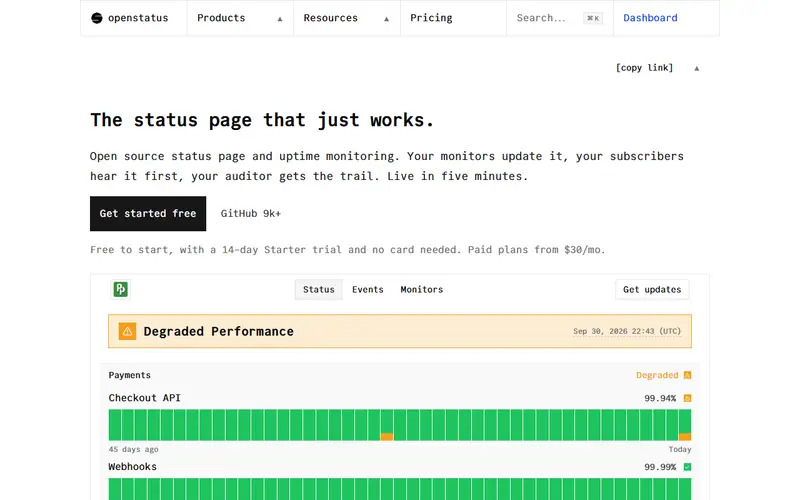
openstatus is a newer open-source project (AGPL-3.0, about 9,000 GitHub stars) that puts status pages first. You get a branded status page on your own domain with themes, maintenance windows and subscriptions by email, RSS or SSH, and it updates itself from uptime monitors that check HTTP, REST and GraphQL endpoints from 28 regions on three cloud providers.
Everything is scriptable: monitors can be versioned as YAML in CI, managed with a CLI, a typed API, a Terraform provider or an MCP server. Private locations run as a single small Docker container to check services behind a firewall.
The hosted service is flat-priced with unlimited team members. The free Hobby tier is only for trying it out (one monitor at 10-minute intervals); Starter at $30 a month is the realistic entry point for a small company that wants a proper status page plus monitoring.
Pricing and plans
Free tier · no card
Hobby plan: 1 monitor, 1 status page with 3 components, checks every 10 minutes at the fastest. No card required.
At the limit Not stated The vendor does not say what happens at the limit, or we have not found it yet.
| Plan | Price | What you get |
|---|---|---|
| Hobby | $0 | 1 monitor, 1 status page with 3 components, 10-minute checks |
| Starter | $30/mo ($300/yr) | 20 monitors, 1-minute checks, 6 regions per monitor, 1 status page, custom domain, 3-month retention |
| Pro | $100/mo ($1,000/yr) | 50 monitors, 30-second checks, all 28 regions, 5 status pages, private locations, OTel exporter, 12-month retention |
| Scale | $500/mo ($5,000/yr) | 10 status pages with 500 components, white label, 24-month retention |
| Enterprise | Custom | SOC 2 reports, custom regions, SLA, invoicing |
What it does
- Status pages
- Custom domains, themes, password protection, maintenance windows and email/RSS/SSH subscriptions.
- Multi-region uptime checks
- 28 regions across 3 clouds; up to 6 per monitor on Starter, all 28 on Pro.
- Monitoring as code
- YAML config, CLI, GitHub Actions, Terraform provider and an MCP server.
- Private locations
- Check internal services with an 8.5 MB Docker image (Pro and above).
- Alerts
- Slack, Discord, email, webhooks, WhatsApp, SMS, PagerDuty, OpsGenie and Grafana OnCall.
- Self-hosting
- AGPL-3.0 code on GitHub for running your own instance.
Strengths and limitations
Strengths
- Open source and self-hostable.
- Unlimited team members on every paid plan.
- Checks from 28 regions on three clouds.
- Monitors can be managed as code and reviewed in pull requests.
Limitations
- Free tier is minimal: one monitor at 10-minute intervals.
- SSO/SAML costs $250 a month on any plan.
- Starter limits each monitor to 6 regions and 3 months of data.
- No error tracking, logs or APM.
Who it suits
Good for
- SaaS companies that need a professional status page
- Teams wanting monitoring as code in CI
- Self-hosters who want an open-source status page
Look elsewhere if
- Hobby projects needing many free monitors
- Application performance or error monitoring
Alternatives to openstatus
| Tool | From | Free option | Stages |
|---|---|---|---|
| Better Stack Uptime, logs, errors and incident management | $29/mo | Free tier | |
| Honeybadger Error tracking, logging, uptime and status pages | $26/mo | Free tier | |
| Sentry Error tracking and application monitoring | $26/mo | Free tier | |
| Axiom Log and event data platform | $25/mo | Free tier | |
| Hyperping Uptime monitoring, status pages and on-call | $24/mo | Free tier | |
| Checkly Synthetic and uptime monitoring as code | $24/mo | Free tier |
Questions
Is openstatus free?
There is a free Hobby plan with one monitor and one status page, and the software is open source for self-hosting.
How much does openstatus cost?
Starter is $30 a month ($300 a year), Pro $100 a month and Scale $500 a month, with unlimited members.
Can I self-host openstatus?
Yes, it is AGPL-3.0 licensed and available on GitHub.
How often does openstatus check my site?
Every 10 minutes on Hobby, every minute on Starter and every 30 seconds on Pro and Scale.
Sources read for this page