Overview
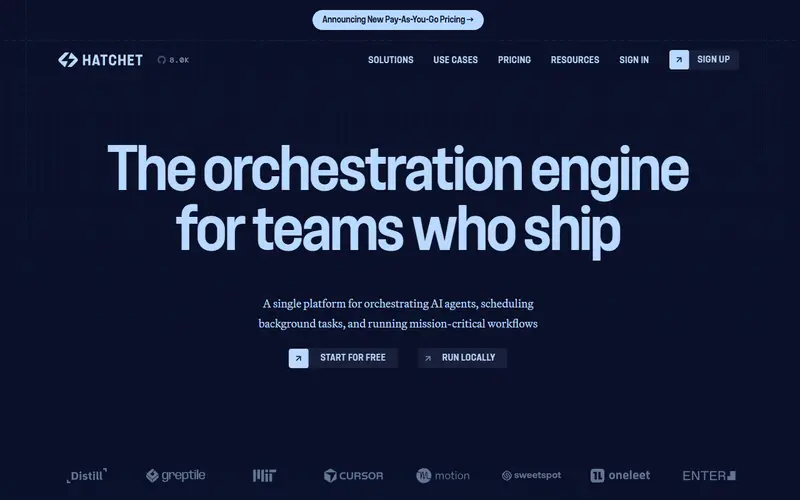
Hatchet is an orchestration engine for background tasks, AI agents and durable workflows. You define tasks as functions in Python, TypeScript, Go or Ruby, run workers that connect to Hatchet, and trigger tasks directly, by event, webhook, cron or schedule. It supports DAG workflows for pipelines and durable tasks that sleep or wait for events and resume after failure.
Unlike Redis- or RabbitMQ-based queues, Hatchet persists every execution in Postgres for the retention period, so failed runs can be inspected and replayed from the dashboard. The maintainers note the trade-off: it has been load-tested to about 10,000 tasks a second but uses more resources than Redis-based systems.
Hatchet Cloud is usage-based. Without a card you get 2,000 runs and events a day; adding a card raises the free allowance to 1 million runs and 1 million events a month, then $30 per million runs and $5 per million events. At a free limit tasks are dropped and new ones error rather than being billed. Custom plans add SSO, RBAC, audit logs, HIPAA and dedicated capacity.
The engine is MIT-licensed and needs only Postgres to self-host, and the cloud data plane runs in the US and Ireland.
Pricing and plans
Free tier · no card
Without a card: 2,000 task runs and 2,000 events a day, 10 workers, 10 cron jobs, 3 users. With a card: 1M runs and 1M events a month free
At the limit Stops at the limit Past a free limit, tasks are dropped and creating new tasks returns errors; you are emailed as you approach the limit.
| Plan | Price | What you get |
|---|---|---|
| Pay-as-you-go, no card | $0 | 2,000 runs and 2,000 events a day, 10 workers, 2,000 worker slots, 10,000 backlog |
| Pay-as-you-go, card on file | $0 then usage | 1M runs and 1M events/month free, then $30/M runs and $5/M events; 100 workers, 10 GB/day active storage, 50 users |
| Custom | Custom | 100M+ runs, dedicated capacity, SSO, RBAC, audit logs, HIPAA BAA, self-hosted or BYOC support |
| Self-hosted | Free | MIT licence, Postgres-backed |
What it does
- Durable task queue
- Execution history is persisted in Postgres, so failed tasks can be inspected and replayed.
- DAGs and durable tasks
- Build pipelines as DAGs or long-running durable tasks with durable sleep and event waits.
- Flow control
- Priorities, static and dynamic rate limits, and fair concurrency keyed by user or tenant.
- Worker routing
- Route tasks by worker labels or weighted affinity, with slot limits per worker.
- Observability
- Real-time dashboard with alerting, OpenTelemetry collection and Prometheus metrics.
- Multi-tenancy
- Isolated tenants for dev, staging and prod, with users and roles.
Strengths and limitations
Strengths
- 1 million free runs a month on cloud once a card is on file
- MIT licence and only Postgres needed to self-host
- Failed runs are kept and replayable, unlike most Redis queues
- EU (Ireland) region available
- Migration guides from Temporal and Celery
Limitations
- Without a card the free cloud tier is capped at 2,000 runs a day
- Tasks are dropped and new ones rejected when a free limit is exceeded
- Higher resource use than Redis- or RabbitMQ-based queues at very high throughput
- SSO, RBAC and audit logs are only on custom plans
- Pay-as-you-go retention is 7 days
Who it suits
Good for
- Python teams replacing Celery with something observable
- AI agent and LLM pipelines needing rate limits and fairness
- Teams that already run Postgres and want to self-host
Look elsewhere if
- Extreme-throughput queues where Redis-based tools use fewer resources
- Projects needing SSO on a small budget
Alternatives to Hatchet
| Tool | From | Free option | Stages |
|---|---|---|---|
| Laravel Horizon Dashboard and worker manager for Laravel Redis queues | — | ||
| Oban SQL-backed job processing library for Elixir (and Python) | $135/mo | ||
| Inngest Durable execution and event-driven workflow platform | $99/mo | Free tier | |
| Vercel Workflows Managed durable workflows on Vercel | Usage-based | Free tier | |
| Solid Queue Database-backed Active Job backend for Rails | — | ||
| Cloudflare Queues Managed message queue for Cloudflare Workers | Usage-based | Free tier |
Questions
Is Hatchet free?
The engine is MIT-licensed. Hatchet Cloud gives 2,000 runs a day without a card, or 1 million runs and 1 million events a month free with a card on file.
How much does Hatchet Cloud cost?
After the free million, $30 per million task runs and $5 per million events, billed monthly.
What happens when I exceed the Hatchet free tier?
Tasks are dropped and new task creation returns errors; Hatchet emails you as you approach the limit.
What does Hatchet need to self-host?
Postgres, which it uses for both the task runtime and observability data.
Is Hatchet a Celery alternative?
Yes. It supports Python and publishes a Celery migration guide, adding persisted history, DAGs and durable tasks.
Sources read for this page