Overview
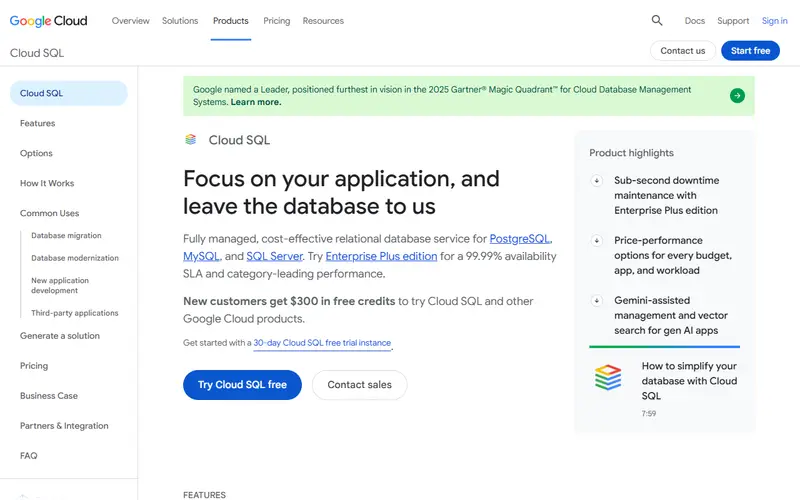
Cloud SQL is Google Cloud's managed service for PostgreSQL, MySQL and SQL Server. Google handles backups, replication, patching, encryption and automatic storage increases, and instances connect privately to Compute Engine, Cloud Run and GKE through VPC or Private Service Connect. Backups support point-in-time recovery with up to 35 days of retention.
There are two editions. Enterprise is the lower-cost option with a 99.95% SLA and includes the shared-core db-f1-micro and db-g1-small machines, the cheapest way to run a small database (from $0.0105/hr for db-f1-micro). Enterprise Plus charges about 30% more per vCPU and GiB, adds a data cache, sub-second maintenance downtime and a 99.99% SLA. Dedicated-core instances are priced per vCPU-hour and GiB-hour, so you size CPU and memory separately.
Costs add up from compute, storage, backups, network egress and high availability, which doubles the compute charge. Committed use discounts of one or three years reduce compute substantially. There is no always-free Cloud SQL instance; use the $300 new-customer credit or the 30-day trial instance to evaluate it.
Pricing and plans
| Plan | Price | What you get |
|---|---|---|
| Shared core db-f1-micro | $0.0105/hr | Shared vCPU, 0.6 GiB RAM; $0.021/hr with HA; Enterprise edition only |
| Shared core db-g1-small | $0.035/hr | Shared vCPU, 1.7 GiB RAM; $0.07/hr with HA |
| Enterprise (dedicated core) | $0.0413 per vCPU-hour + $0.007 per GiB-hour | us-central1 rates; up to 96 vCPUs and 624 GiB; HA doubles the rate; 99.95% SLA |
| Enterprise Plus | $0.0537 per vCPU-hour + $0.0091 per GiB-hour | us-central1 N2 rates; up to 128 vCPUs and 864 GiB; data cache; 99.99% SLA |
| Committed use discounts | Custom | 1-year and 3-year commitments; e.g. Enterprise vCPU $0.030975 (1 yr) or $0.019824 (3 yr) per hour |
What it does
- Three engines
- PostgreSQL, MySQL and SQL Server, with extension and flag support, including pgvector for vector search.
- Two editions
- Enterprise with a 99.95% SLA, or Enterprise Plus with a 99.99% SLA, data cache and near-zero maintenance downtime.
- High availability
- Regional instances fail over automatically across zones; read replicas can span regions.
- Backups and PITR
- Automated backups with point-in-time recovery up to 35 days; enhanced backups add immutable copies.
- Custom machine sizes
- Pick vCPUs and memory independently, up to 128 vCPUs and 864 GiB on Enterprise Plus.
- Google Cloud integration
- Works with Cloud Run, GKE, IAM, BigQuery federated queries and Datastream change data capture.
Strengths and limitations
Strengths
- Over 40 regions, including many in Europe
- Very small shared-core instances for low-traffic apps
- Fine-grained CPU and memory sizing
- Point-in-time recovery up to 35 days
- Stated ISO 27001, PCI DSS and HIPAA support
Limitations
- No permanent free tier, only credits and a 30-day trial instance
- High availability doubles the compute price
- Storage, backups and egress are billed on top of compute
- Shared-core machines are Enterprise edition only and are not covered by the higher SLA
Who it suits
Good for
- Apps on Cloud Run, GKE or Compute Engine
- Teams needing data residency in a specific Google Cloud region
- Production PostgreSQL or MySQL with a 99.95-99.99% SLA
- SQL Server workloads moving to a managed service
Look elsewhere if
- Hobby projects that want a free database
- Workloads that should scale to zero when idle
Alternatives to Google Cloud SQL
| Tool | From | Free option | Stages |
|---|---|---|---|
| Scalingo European managed PaaS | €7.20/mo | ||
| MongoDB Atlas Managed document database | $8/mo | Free tier | |
| Render Managed PaaS | $7/mo | Free tier | |
| Xata Managed PostgreSQL with copy-on-write branching | $0.012/hr | ||
| Clever Cloud European managed PaaS | €6/mo | ||
| Crunchy Bridge Managed PostgreSQL on AWS, Azure and GCP | $9/mo |
Questions
Does Google Cloud SQL have a free tier?
No always-free tier. New Google Cloud customers get $300 in credits, and Cloud SQL offers a 30-day free trial instance.
What is the cheapest Cloud SQL instance?
db-f1-micro, a shared-core machine with 0.6 GiB RAM at $0.0105 per hour in us-central1, plus storage; Google's example test instance costs $9.37/mo.
What is the difference between Cloud SQL Enterprise and Enterprise Plus?
Enterprise has a 99.95% SLA and lower prices; Enterprise Plus costs more per vCPU and GiB but adds a data cache, larger machines, sub-second maintenance downtime and a 99.99% SLA.
How long does Cloud SQL keep backups?
Point-in-time recovery can be configured with a retention period of up to 35 days.
Does high availability cost extra on Cloud SQL?
Yes. HA vCPU and memory are priced at double the standard rate, and replicas cost the same as stand-alone instances.
Sources read for this page