Overview
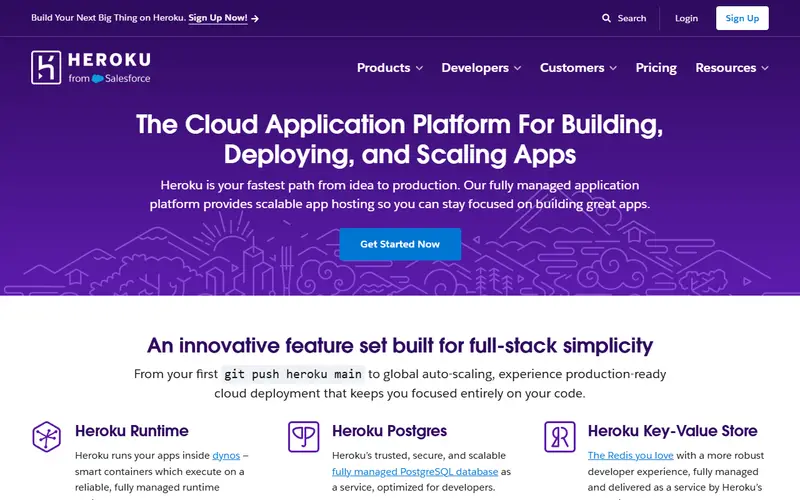
Heroku popularized git push deploys: you push code, a buildpack detects the language and builds a slug, and dynos run it. Around that sit Heroku Postgres, Key-Value Store (Redis), pipelines with review apps for every pull request, one-click rollbacks, and more than 150 third-party add-ons for logging, email, search and the like.
There is no free tier. Eco dynos cost $5 a month for a shared pool of hours on personal accounts and sleep after 30 minutes without traffic; Basic dynos are $7 each and always on. Standard dynos ($25 and $50) add horizontal scaling and zero-downtime preboot, Performance dynos ($250 and up) add dedicated compute and autoscaling, and Private and Shield dynos run in isolated Private Spaces for regulated workloads.
On 6 February 2026 Heroku announced a move to a 'sustaining engineering' model focused on stability, security and support rather than new features, and stopped offering Enterprise Account contracts to new customers. Credit-card customers, new and existing, can still sign up with unchanged pricing. That makes Heroku a reasonable place to keep a working app, but a riskier choice for a new long-term project.
Common Runtime apps run in the US or EU; Private Spaces add ten regions including Frankfurt, Tokyo and Sydney.
Pricing and plans
| Plan | Price | What you get |
|---|---|---|
| Eco | $5/mo | Shared pool of dyno hours for personal accounts; dynos sleep after 30 minutes idle |
| Basic | $7/mo per dyno | 0.5 GB, always on, 10 process types |
| Standard-1X | $25/mo per dyno | 0.5 GB, horizontal scaling, preboot, metrics |
| Standard-2X | $50/mo per dyno | 1 GB |
| Performance-M | $250/mo per dyno | 2.5 GB dedicated, autoscaling |
| Private-S | $125/mo per dyno | Requires a Private Space; network isolation |
| Shield-S | $150/mo per dyno | HIPAA BAA and PCI capable; Private Space required |
What it does
- Buildpacks
- Official support for major languages and 380+ open-source buildpacks for anything that runs on Linux.
- Pipelines and review apps
- Promote builds from staging to production and spin up a disposable app for every GitHub pull request.
- Heroku Postgres
- Managed Postgres 16 to 18 with continuous physical backups and free daily logical backups; higher tiers add followers, forks and rollback.
- Add-ons marketplace
- 150+ third-party services provisioned and billed through Heroku.
- Private Spaces and Shield
- Network-isolated runtimes in ten regions; Shield dynos support HIPAA BAAs and PCI.
- Fine-grained access control
- Per-capability permissions (deploy, scale, view logs, manage billing) for all customers since August 2026.
Strengths and limitations
Strengths
- Mature, well-documented workflow that many developers already know.
- Large add-on ecosystem billed on one invoice.
- Compliance options (HIPAA, PCI) through Shield.
- Predictable per-dyno pricing.
Limitations
- No free tier; the cheapest dynos (Eco) sleep after 30 minutes idle.
- In sustaining-engineering mode since February 2026, with few new features planned.
- New customers can no longer buy Enterprise Account contracts.
- Only two regions (US, EU) outside Private Spaces.
- Essential Postgres plans have no forks, followers or Postgres logs and 99.5% expected uptime.
Who it suits
Good for
- Existing Heroku apps that work and need no new platform features
- Teams that rely on Heroku add-ons and pipelines
- Small production apps paid by credit card
Look elsewhere if
- New enterprise projects that need a long-term vendor roadmap
- Free hobby hosting
Pricing history
-
Heroku moves to sustaining engineering and stops selling Enterprise contracts
Announced 6 Feb 2026: Heroku will focus on stability and security rather than new features, and Enterprise Account contracts are no longer offered to new customers. Credit-card pricing and billing are unchanged. Source ↗
Alternatives to Heroku
| Tool | From | Free option | Stages |
|---|---|---|---|
| Cloudflare Workers (incl. Pages) Edge serverless platform | $5/mo | Free tier | |
| Clever Cloud European managed PaaS | €6/mo | ||
| Render Managed PaaS | $7/mo | Free tier | |
| Scalingo European managed PaaS | €7.20/mo | ||
| Northflank Kubernetes-based PaaS | $2.70/mo | Free tier | |
| Netlify Frontend and serverless platform | $9/mo | Free tier |
Questions
Does Heroku have a free tier?
No. The cheapest option is the $5/month Eco plan, whose dynos sleep after 30 minutes of inactivity.
Is Heroku shutting down?
No shutdown has been announced. Since 6 February 2026 it runs in a sustaining engineering model with no new Enterprise contracts, while credit-card customers keep the same pricing and service.
What is the cheapest always-on Heroku dyno?
The Basic dyno at $7/month with 0.5 GB of RAM.
Which regions does Heroku support?
US and EU in the Common Runtime; Private Spaces add Dublin, Frankfurt, London, Montreal, Mumbai, Oregon, Singapore, Sydney, Tokyo and Virginia.
Sources read for this page